The Mushroom Festival 2026: An Honest Guide to San Mateo Río Hondo, Oaxaca
Share this guide 👀
July 31–August 2, a Zapotec mountain village in Oaxaca's Sierra Sur opens its cloud forests for three days. No false mysticism, no tourist markup — everything you need to know before you go.
By
mish Dary
Director de Qué Onda Oaxaca
10 min
Photo: Imagen ilustrativa / no es propiedad del autor
The small mountain village of San Mateo Río Hondo sits at 2,300 meters (7,500 feet) above sea level in Oaxaca's Sierra Sur — a pine-forested southern mountain range where clouds roll in without warning and the air always carries the smell of recent rain. From July 31 to August 2, the village celebrates its sixth annual Festival del Hongo (Mushroom Festival).
I'm not from San Mateo Río Hondo. I'm Oaxacan — from the Mixe highlands, a different region — and I'm writing this as an outsider who has visited and wants people to arrive prepared, not as someone speaking on behalf of that community. That said, I owe you honesty: my first experience with mushrooms was in a forest just like this, with friends, no cameras, no guide charging in dollars. I'm not a spiritual person, so for me it was simply one of the best experiences I've had — forest, good company, and my own thoughts. I didn't need more than that. But if the spiritual dimension resonates with you, it also means being aware of where you're standing and whose land and practices you're stepping into.
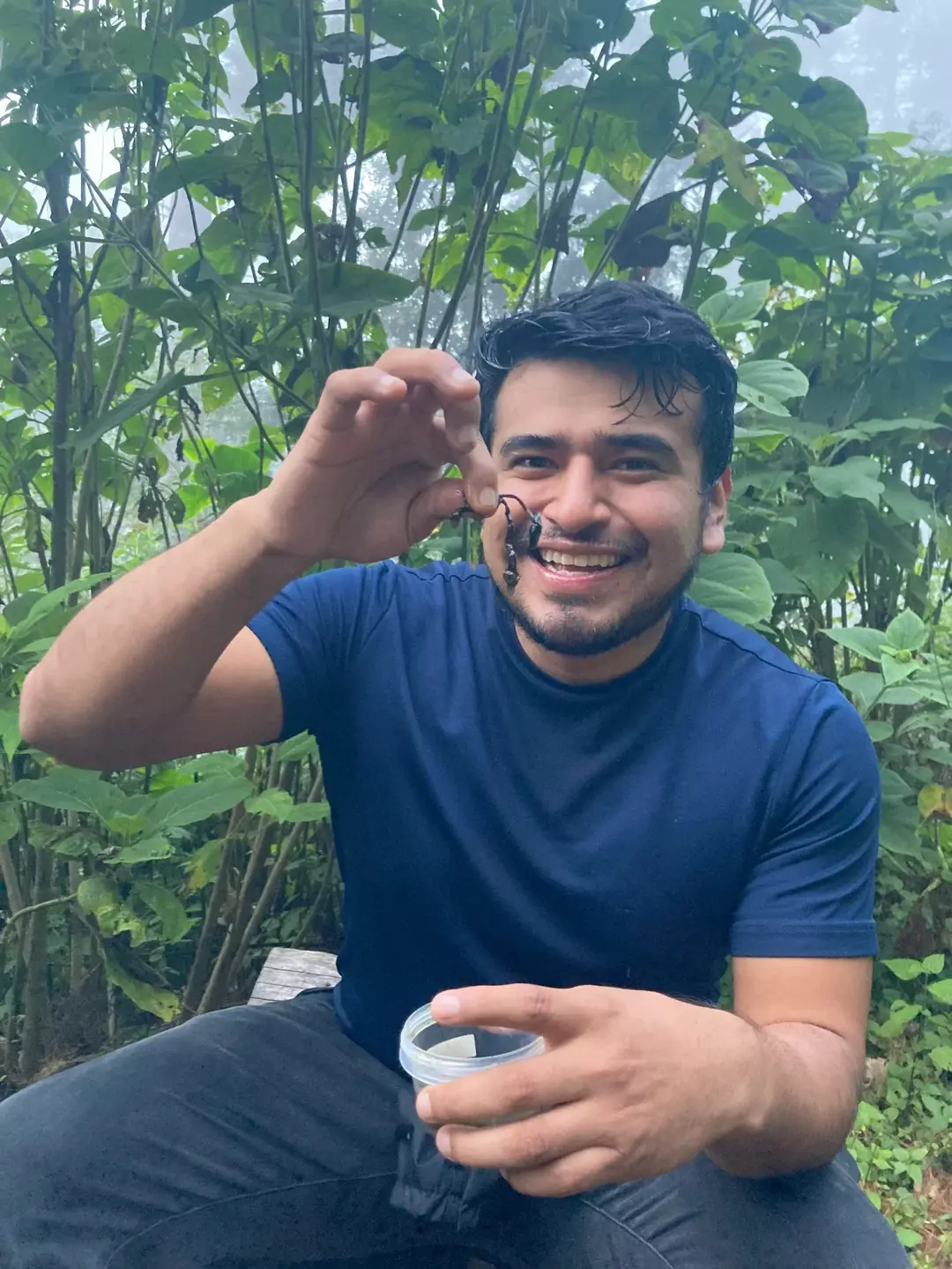
The author with his first mushroom in San José del Pacífico
Author's own photo. First time, forest, good company. That's all.
What the Festival Actually Is
— mish Dary :)
I'm Mish Dary — 'Dary' in the Mixe language — from San Juan Juquila Mixes, a small mountain village in Oaxaca. I was on track to become a priest, ended up as a mechatronics engineer and total nerd, and somehow landed here writing about mole, calendas, and concerts in borrowed courtyards. I built Qué Onda Oaxaca with my own hands — a meeting point and a little bridge so everyone can enjoy this land. No curated culture for the few: I'll tell you about an opening with free wine just as gladly as a mayordomía at 3 a.m. Passionate about cinema (@cineyekuk), making videos, parties, and mezcal.
Since 2019, San Mateo Río Hondo has organized this festival with a straightforward goal that Instagram rarely emphasizes: spreading mycological knowledge from the region. Think expert lectures, mushroom identification workshops, traditional seta cuisine, a costumed parade with cash prizes, and a basket competition where you donate your foraged mushrooms to a table of trained mycologists for classification. At its core, this is a festival about biodiversity and traditional knowledge from a Zapotec indigenous community in Oaxaca's southern mountains. Psychedelic mushrooms — called niños santos (sacred children) in local tradition — are part of the landscape, yes, but they're not the whole festival, even if the tourist marketing (mine included, let's be honest) tends to lead with that.
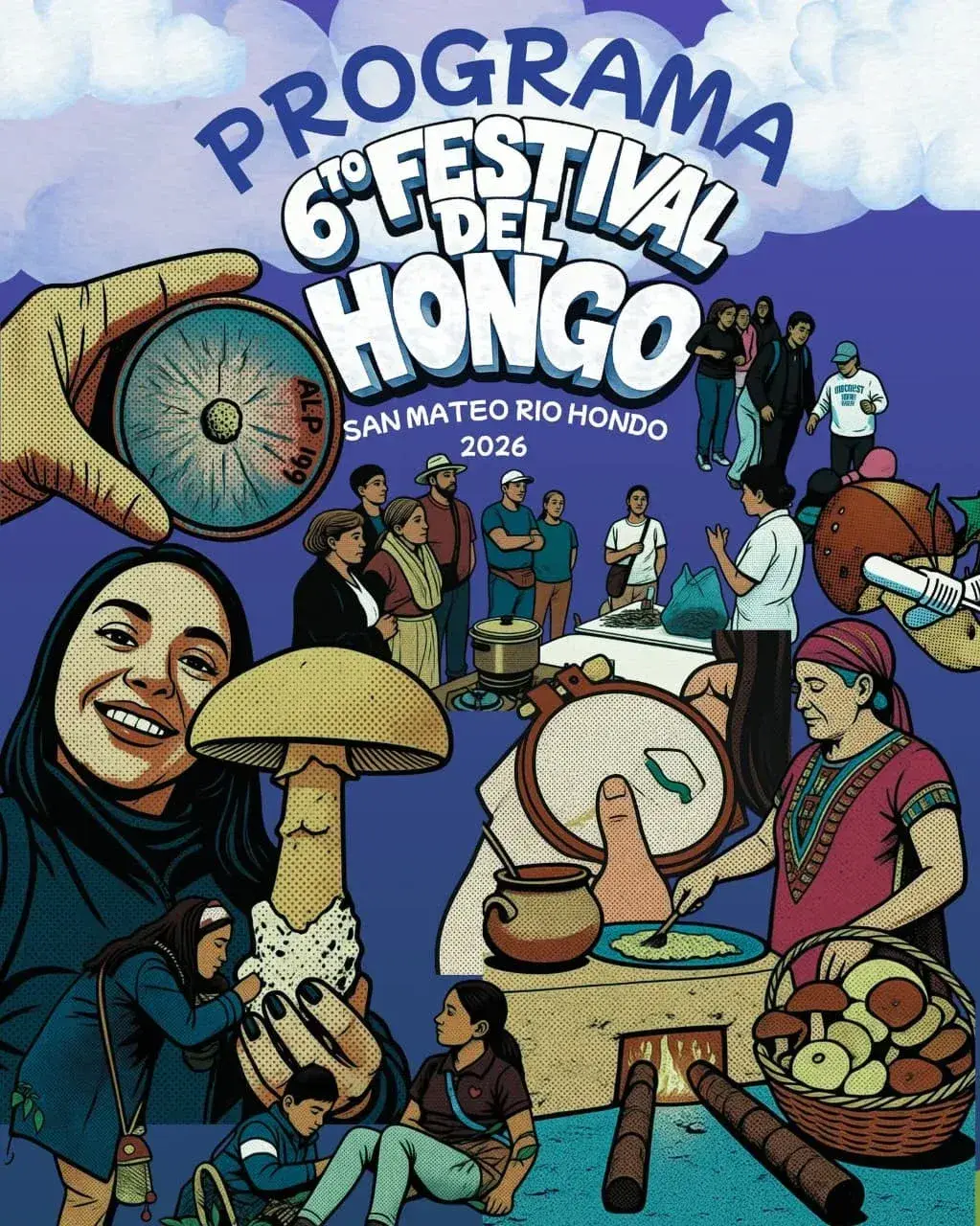
Mushroom Festival 2026 — official poster
Image from the festival organization / not the author's property.
2026 Festival Schedule
Image from the festival organization / not the author's property.
Spiritual, Recreational, and the Deeper Question: Respect
I'll skip the debate about whether mixing mushroom culture with New Age rituals or outside "shamans" is problematic — that's a conversation happening in every mezcal bar in Oaxaca and you can find it anywhere. For me, it's simpler: it's about respecting local practices and being honest with yourself. If you're consuming recreationally, say so, live it that way, enjoy it. If you're looking for a spiritual experience, find the spaces the community itself organizes for that, understand where those practices come from, and don't buy "express enlightenment" from the first person who offers it on the street.
The transformation of Huautla de Jiménez — birthplace of María Sabina, the Mazatec healer who introduced psilocybin mushrooms to Western audiences — into a place where families compete to sell ceremonies is a well-documented cautionary tale. A similar pressure is starting to be felt in San José del Pacífico and, to a lesser extent, in San Mateo: practices like the temazcal (traditional sweat lodge) are sometimes offered disconnected from their cultural context because "it looks good on a wellness itinerary." Even travel guides written by foreigners recommend vetting who you do a ceremony with — because spiritual tourism, when money's involved, is easily exploited. The festival organization's own program says it clearly: understanding the origin and meaning of these practices is what allows you to experience them with respect. And not just for ethical reasons — a poorly understood, poorly guided ceremony is also a less safe experience.
How to Get There
Both main routes pass through Highway 175, the mountain road connecting Oaxaca City to the Pacific Coast through the Sierra Sur.
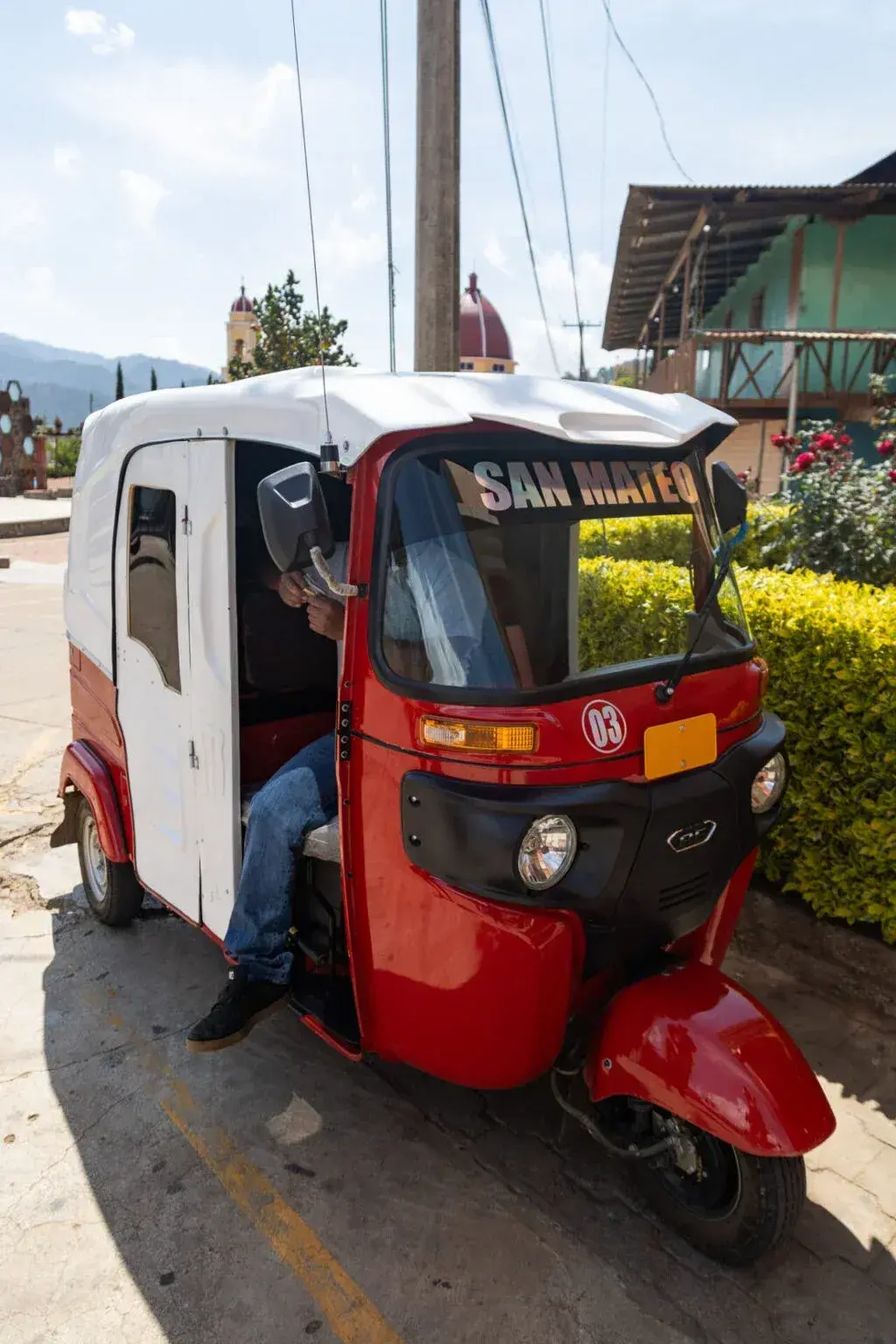
From the Coast (Pochutla / Huatulco): Take Highway 175 toward Miahuatlán, about 94 km to the Zapotitlán turnoff (look for the arch), then 10 km more to San Mateo. By public bus, take Líneas Unidas from Pochutla toward Miahuatlán, get off at the Zapotitlán crossroads — 10 minutes before San José del Pacífico — and take a shared taxi or mototaxi. Budget about 3 hours total.
From Oaxaca City: Take Highway 175 toward Pochutla, about 145 km. Ten minutes after passing San José del Pacífico you'll see the Zapotitlán turnoff; from there, 10 km to San Mateo. Líneas Unidas departs from Bustamante at Xóchitl in the city center (Eclipse 70 also runs the same route), with tickets around $7–9 USD to San José del Pacífico or the crossroads; then take a shared taxi or mototaxi for the last stretch. Budget 3.5–4 hours. Honestly, this is the route I'd choose: cheap, local, and gives you a sense of the journey.
Private taxis from Oaxaca run between $40–$150 USD depending on negotiation. If you're coming from outside Mexico: negotiate the price before you get in, and if something feels too high, ask your accommodation for the going rate before you leave.
From Mexico City: Líneas Unidas has a direct overnight route to Miahuatlán de Porfirio Díaz; from there, take a taxi to any of the transport hubs serving San Mateo Río Hondo and board a shared van (colectivo) to the village.
Renting a Car: Oaxaca's international airport has major agencies including Hertz, National, Enterprise, Europcar, and MEX Rent A Car (verify availability in advance). Local independent agencies in the city are sometimes cheaper. Renting makes sense if you want to stop in San José del Pacífico on the way. That said, Highway 175 through the Sierra involves constant mountain curves, fog, and rain in season — drive it in daylight, take it slow.
This article contains affiliate links. If you book or hire through them, I earn a small commission at no extra cost to you. Thanks for supporting Qué Onda Oaxaca.
Want to walk it? There's a dirt trail connecting San José del Pacífico to San Mateo Río Hondo — about 9 km (5.6 miles), 2–3 hours through cloud forest. On the way back, take a shared taxi (around $5 USD per person). It's one of the better ways to arrive.
On "all-inclusive" tour packages: They exist, and some solve transport, guide, and accommodation in one bundle. Before booking, ask a simple question: who in the community benefits from this? With the festival's growing profile, outside operators have moved in without necessarily supporting the people who built this culture. Prioritize local guides and operators directly tied to the community when you can.
The festival includes guided tours with mycologists and local guides every day, departing every hour from 8:00 am:
▸Mushroom observation tour: $13 USD (~$250 MXN)
▸Foraging and tasting tour: $18 USD (~$350 MXN)
▸Tour with photography workshop: $18 USD (~$350 MXN)
There's a free workshop on integrating sacred mushroom experiences, using systemic therapy approaches, led by Carlos Moriano on August 1 at noon in the Municipal Library (limited spots). Saturday brings a mushroom-dye textile workshop with Gabriela Coronado, and Sunday a backstrap loom workshop for children.
The costume parade and basket competition both offer cash prizes up to $1,500 MXN (~$75 USD) — arrive early on the first morning to register. The festival closes with a four-directions ceremony led by the Tokani collective.
Festival schedule — day 1
Image from the festival organization / not the author's property.
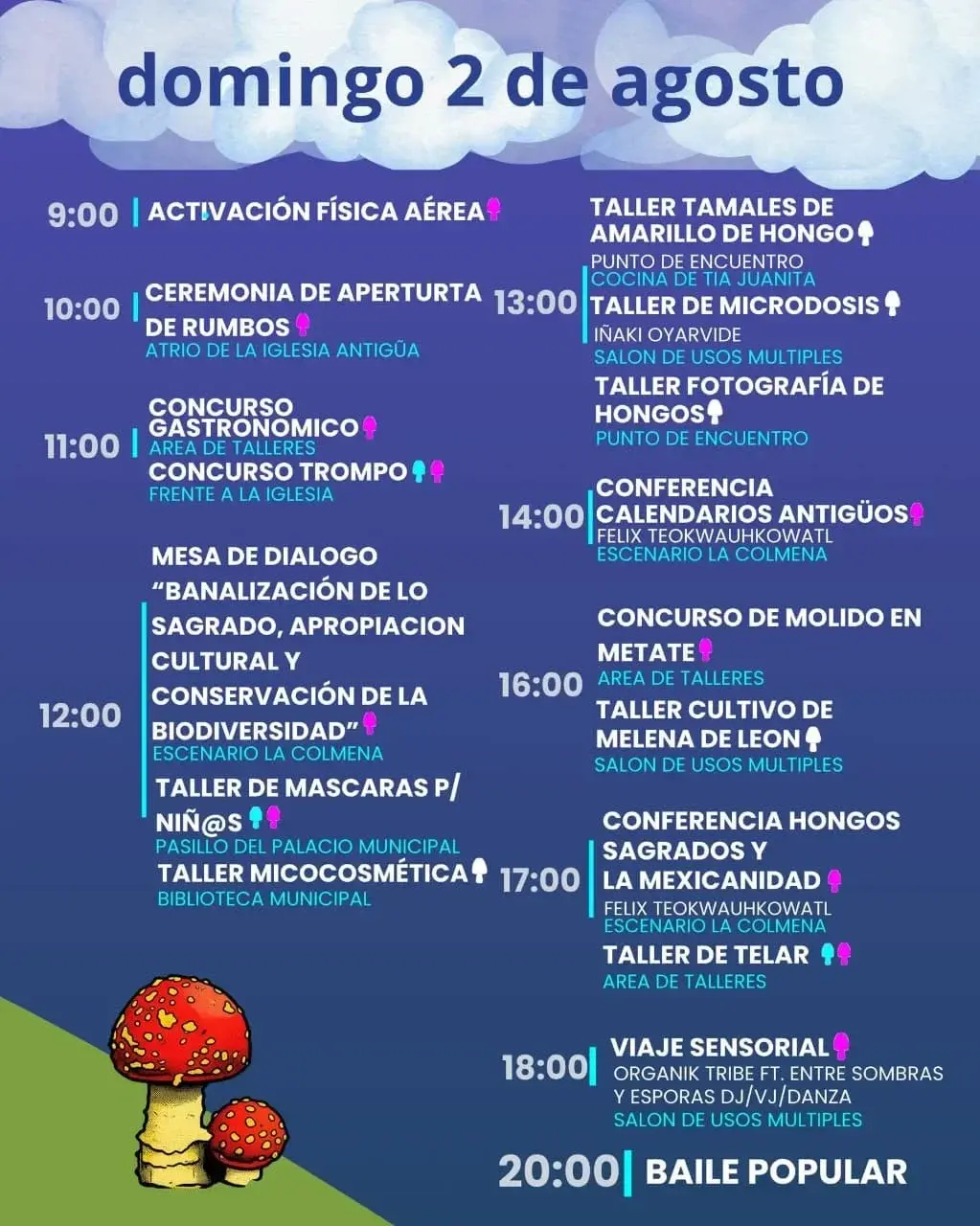
Festival schedule — day 2
Image from the festival organization / not the author's property.
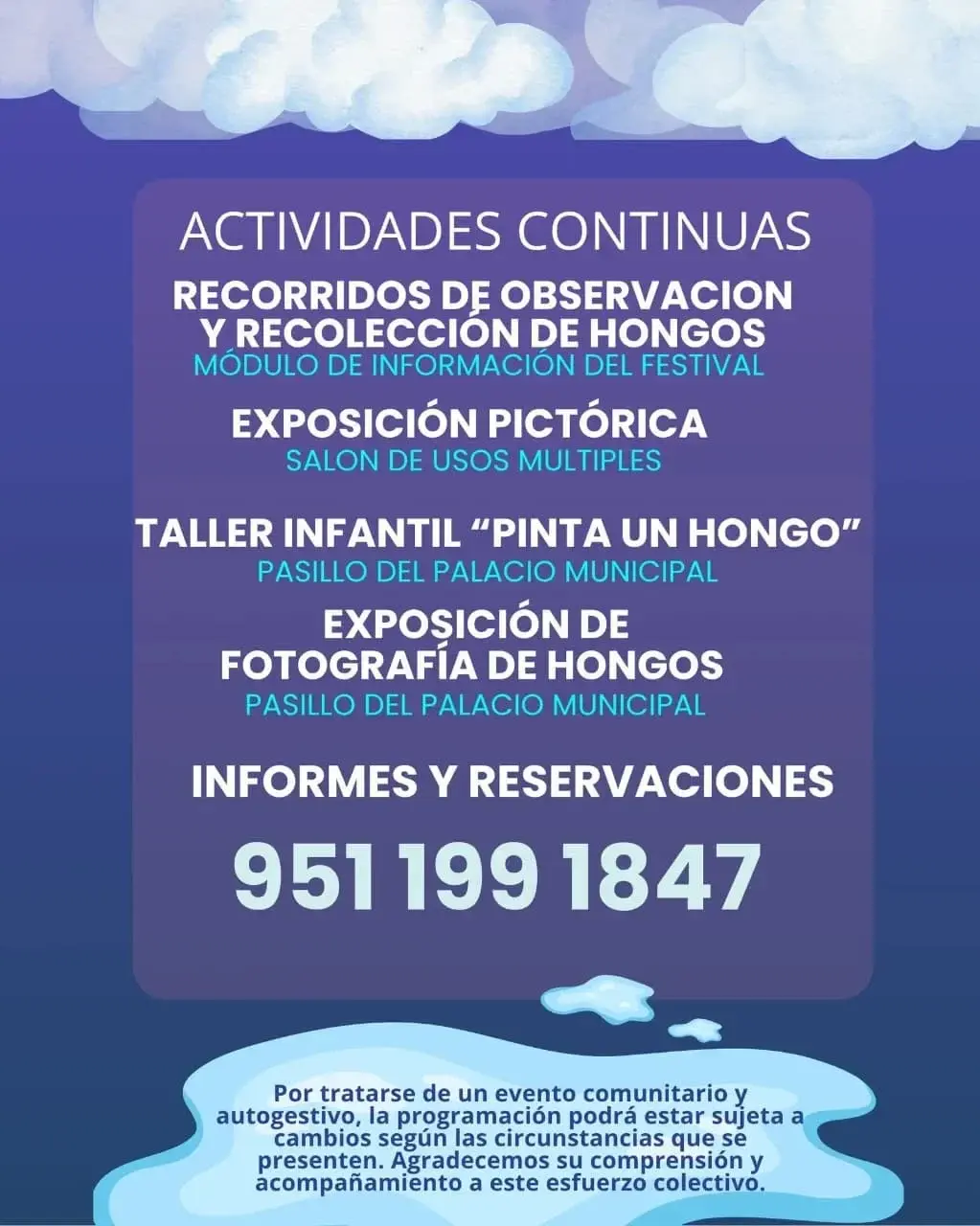
Festival activities
Image from the festival organization / not the author's property.
Best Time to Visit San Mateo Río Hondo
Mushroom season runs from July through October, aligned with Oaxaca's rainy season — the conditions that allow dozens of edible, medicinal, and psychoactive species to emerge in the cloud forest. The festival is timed right at the start of that window.
If you're coming for the festival (July 31–August 2), you're already arriving at peak time. Outside the festival, July through September is the ideal range for wild mushrooms. The dry season (November through April) offers clearer skies and better hiking conditions, but the fungi largely disappear.
Year-round, the climate in San Mateo and San José del Pacífico stays cool: 15–25°C (60–77°F) during the day, dropping to 8–15°C (46–59°F) at night. In rainy season, cloud cover can arrive mid-morning and temperatures drop quickly. Always carry a jacket and rain layer, even on sunny mornings.
Budget: What to Bring
There is no ATM in San Mateo Río Hondo. The nearest is in San José del Pacífico (not always operational) or in Miahuatlán. Bring enough cash for your entire stay.
Expense
Approximate Cost
Bus Oaxaca → Zapotitlán crossroads
$7–9 USD
Shared taxi / mototaxi to San Mateo
$1.50–4 USD
Private taxi from Oaxaca
$45–100 USD
Car rental from Oaxaca (1 day)
from ~$20 USD
Basic accommodation in San Mateo
$10–20 USD / night
Accommodation in San José del Pacífico
$8–30 USD / night
Hammock or camping spot
$5–8 USD / night
Guided mushroom observation tour
$13 USD
Foraging and tasting tour
$18 USD
Meal at local comedor
$4–8 USD
Local artisan mezcal (glass)
from $3 USD
Minimum daily budget (public transport, local food, one activity): ~$30–40 USD
Comfortable daily budget (accommodation, one festival tour, meals, extras): ~$60–100 USD
Where to Eat in San Mateo Río Hondo
San Mateo is a small village. Outside festival season, food options are basic: a couple of family-run comedores with a fixed daily menu (soup, stew, tortillas). During the festival, temporary stalls take over with mushrooms as the featured ingredient.
What to look for:
▸Sautéed mushrooms with garlic and epazote — the most direct and most honest preparation
▸Mushroom soup with serrano chili — especially good when the fog rolls in
▸Sierra-style tlayuda — simpler than Oaxaca City versions, with local string cheese and black beans
▸Memelas with hierba santa sauce — classic mountain breakfast
▸Hibiscus water and guava atole — for the early-morning cold
Practical note: arrive hungry on the first morning of the festival. Food stalls sell best before noon, and anything mushroom-based tends to sell out quickly.
Hiking and Nature: Cloud Forest Trails
The zone between San José del Pacífico and San Mateo Río Hondo contains one of Oaxaca's best-preserved pine-oak cloud forests.
San José del Pacífico → San Mateo trail (9 km / ~2.5 hours): A dirt forest track with moderate elevation and almost no traffic. Fog can close visibility fast. Bring water, layers, and snacks. Return by shared taxi (~$5 USD per person).
Festival guided tours (from 8:00 am daily): Mycologists lead small groups into the forest to identify mushrooms, explain their ecology, and — in the foraging tour — prepare them for eating. This is the safest and most educational way into the forest if you don't know the area.
Good to know:
▸Cloud forest visibility changes in minutes. Bring a headlamp.
▸Edible, medicinal, and toxic mushrooms look remarkably similar here. Never eat anything without expert confirmation.
▸Wildlife includes raccoons, opossums, coyotes, and deer at higher elevations. No serious risk, but don't wander alone at night.
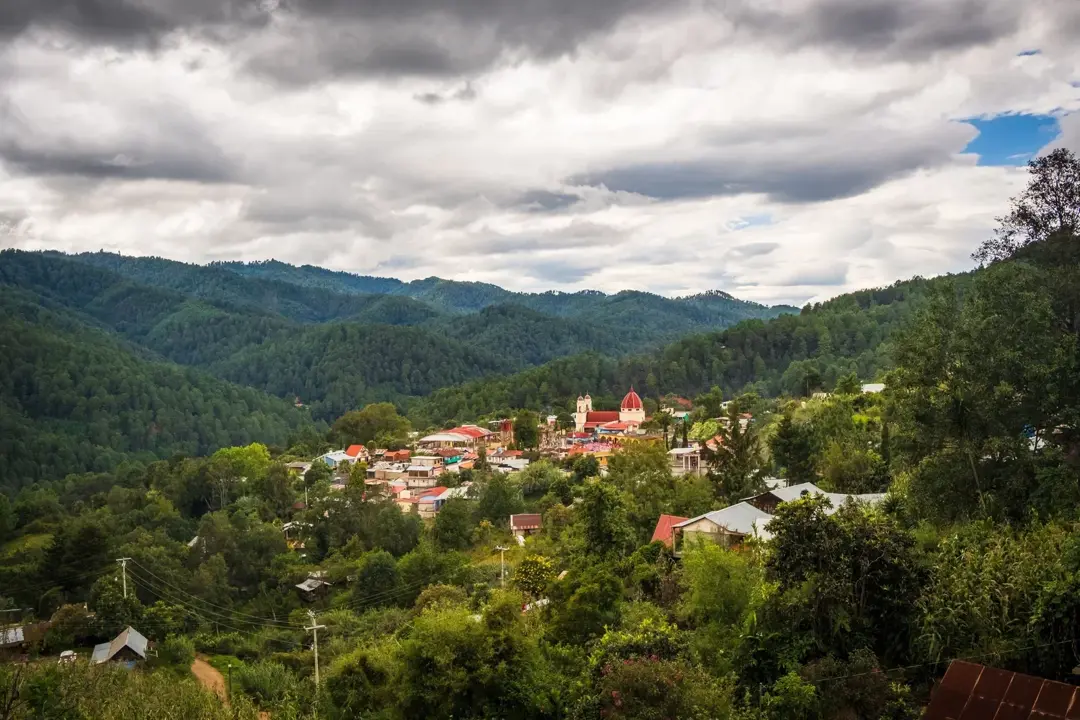
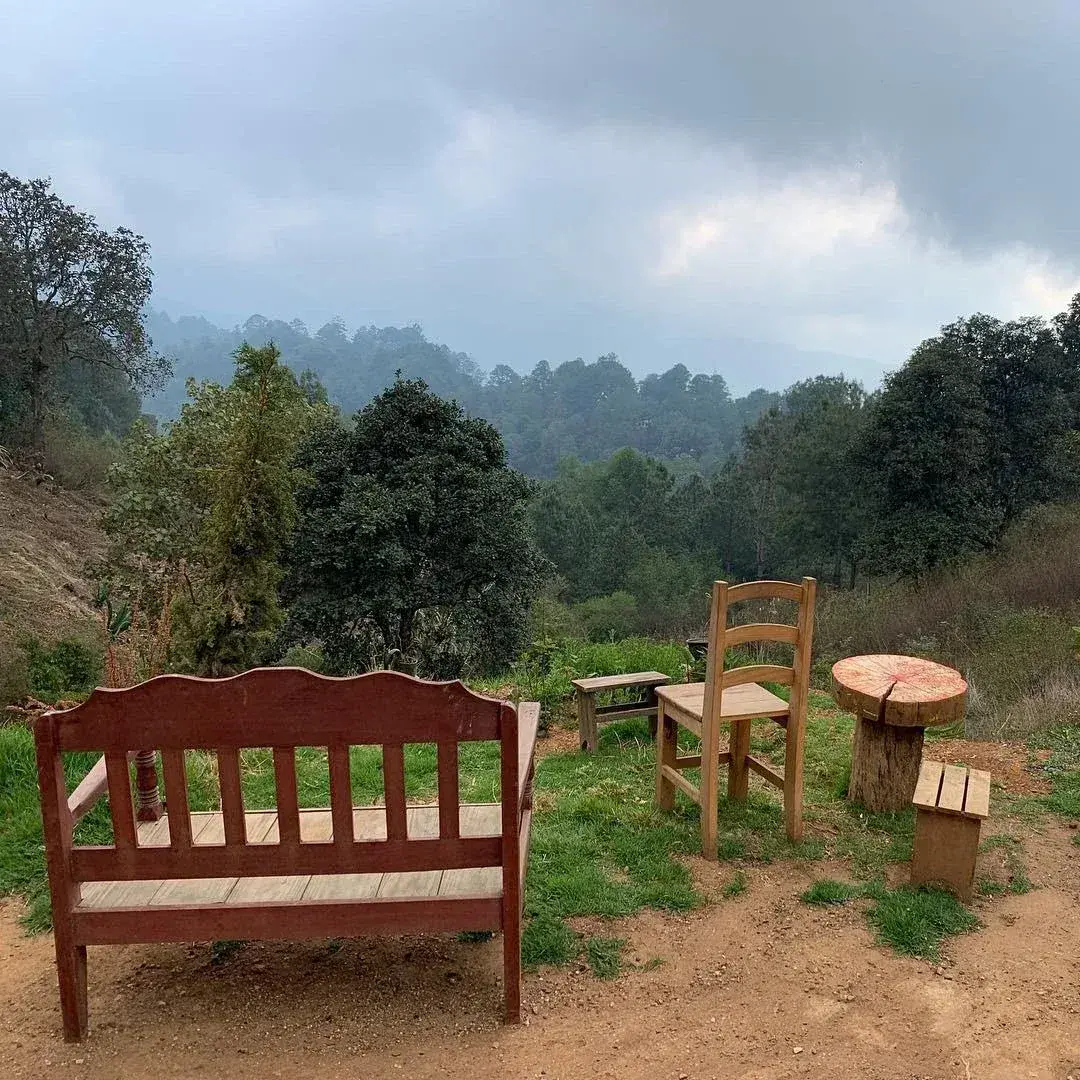
View of San Mateo Río Hondo
Illustrative image / not the author's property.
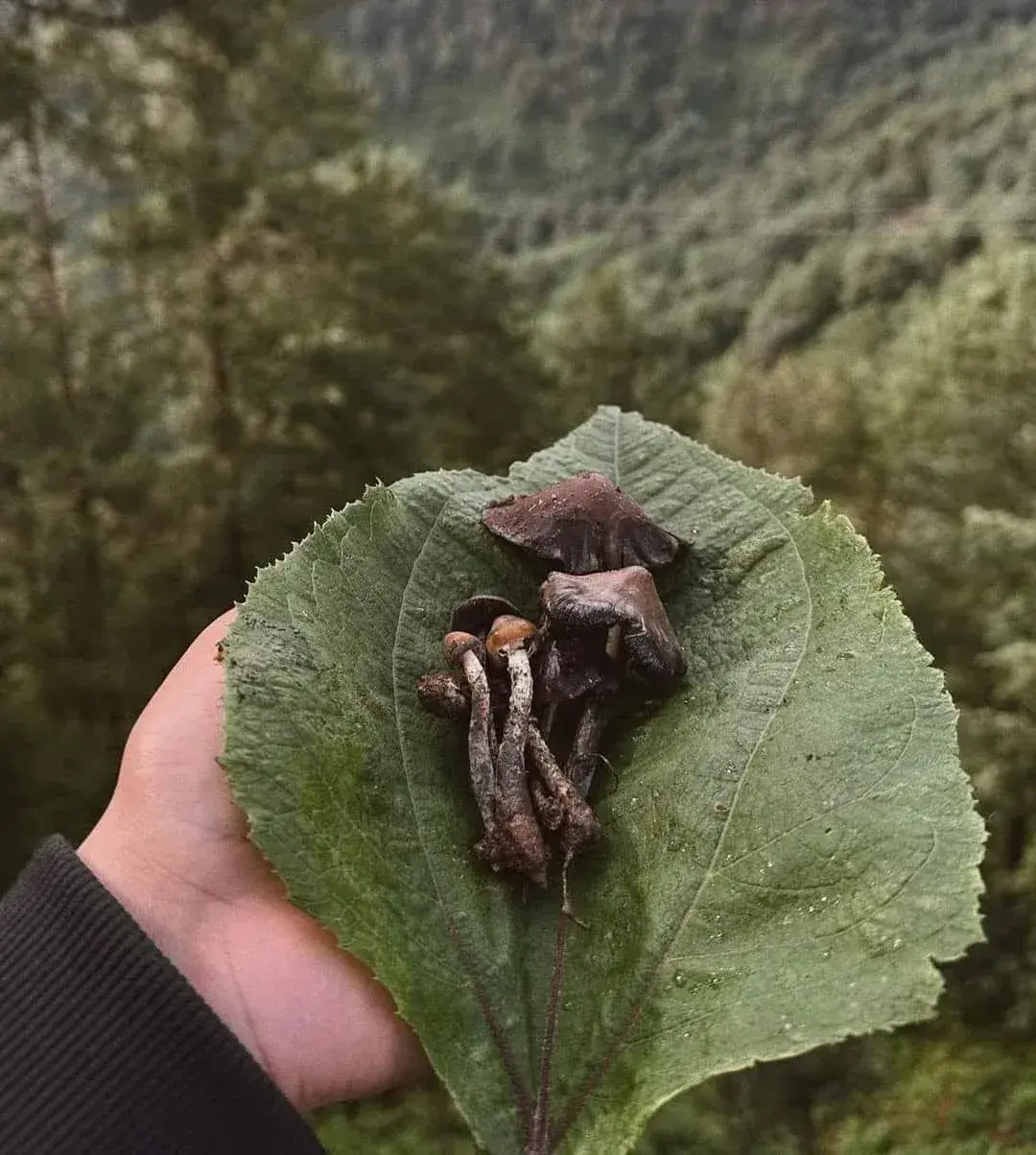
Wild mushrooms of San Mateo Río Hondo
Illustrative image / not the author's property.
Safety, Legality, and Honest Advice
I'm not your doctor or your lawyer. This is common sense, not a prescription:
▸Go with people you trust. The forest, the right company, and unhurried time are honestly half the experience.
▸Get anything you plan to consume identified by someone who knows. The festival's expert classification table exists for exactly this. Edible and toxic species look more alike than you'd think.
▸Dress for mountain weather. At 2,300 meters, fog and rain arrive fast even in August. Bring a jacket and waterproof layer regardless of what the forecast says.
▸Keep someone sober. If anyone in the group is consuming, have someone stay clear-headed for logistics and emergencies.
▸Medical history matters: If you have a cardiac condition, psychiatric history, or are pregnant, this festival isn't for you right now — talk to a doctor you trust, not just the internet.
▸The legal situation in Mexico: Psilocybin remains classified as a prohibited substance under Mexico's General Health Law. Traditional ceremonial use in indigenous communities is culturally tolerated — but that is not the same as being legal. As a foreign visitor, the stakes of getting this wrong are higher. Be informed before you go.
▸You're a guest. If invited to an altar, ceremony, or community discussion, show up as a guest — not a tourist with a camera.
San José del Pacífico: If You Have an Extra Day
About 10 km up Highway 175 from the San Mateo turnoff sits San José del Pacífico, better known to international travelers, largely because it sits right on the main road and has been on the backpacker circuit for years. It's a useful complement — or base — for the festival:
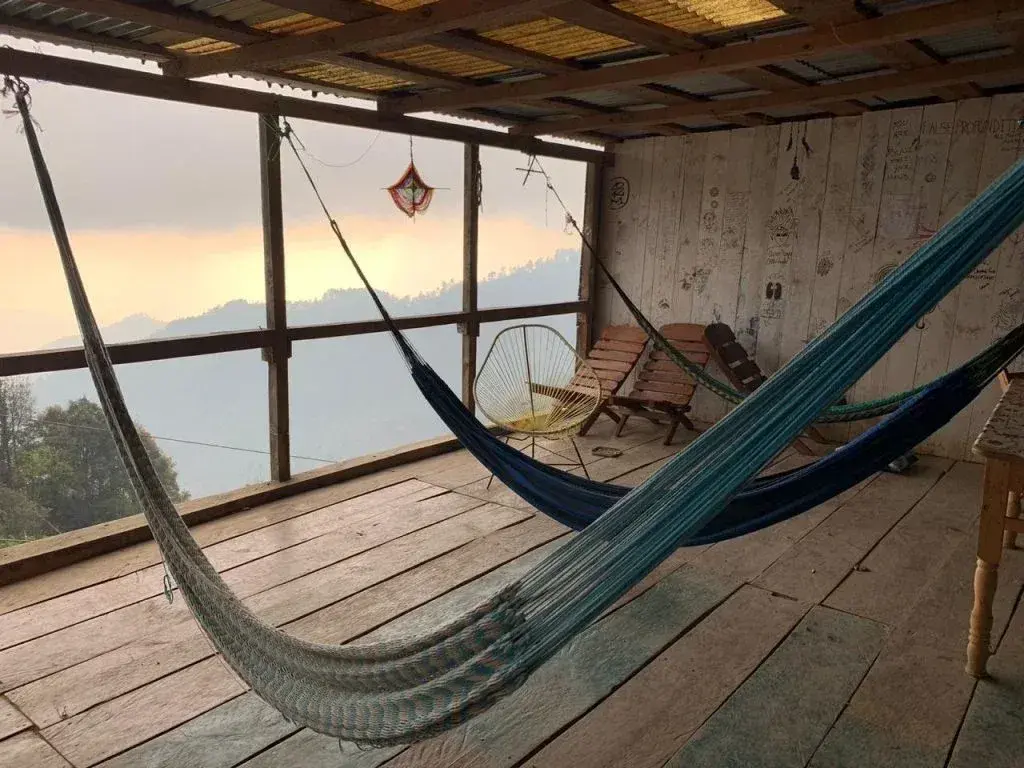
▸More accommodation choices: hostels, wooden cabins, hammocks with cloud-sea views. Book ahead during festival dates.
▸Better highway access: buses stop directly here. From San José, mototaxis or shared taxis cover the remaining 10 km to San Mateo.
▸More traveler infrastructure: cafes, small restaurants with vegetarian options, a more international crowd.
▸The sunsets: when the fog drops at dusk and you can see the Pacific on the horizon — one of the best views in the Oaxacan highlands.
If the festival is your main objective, stay in San Mateo for those three days. But if you arrive a day early or stay a day after, San José is worth it.
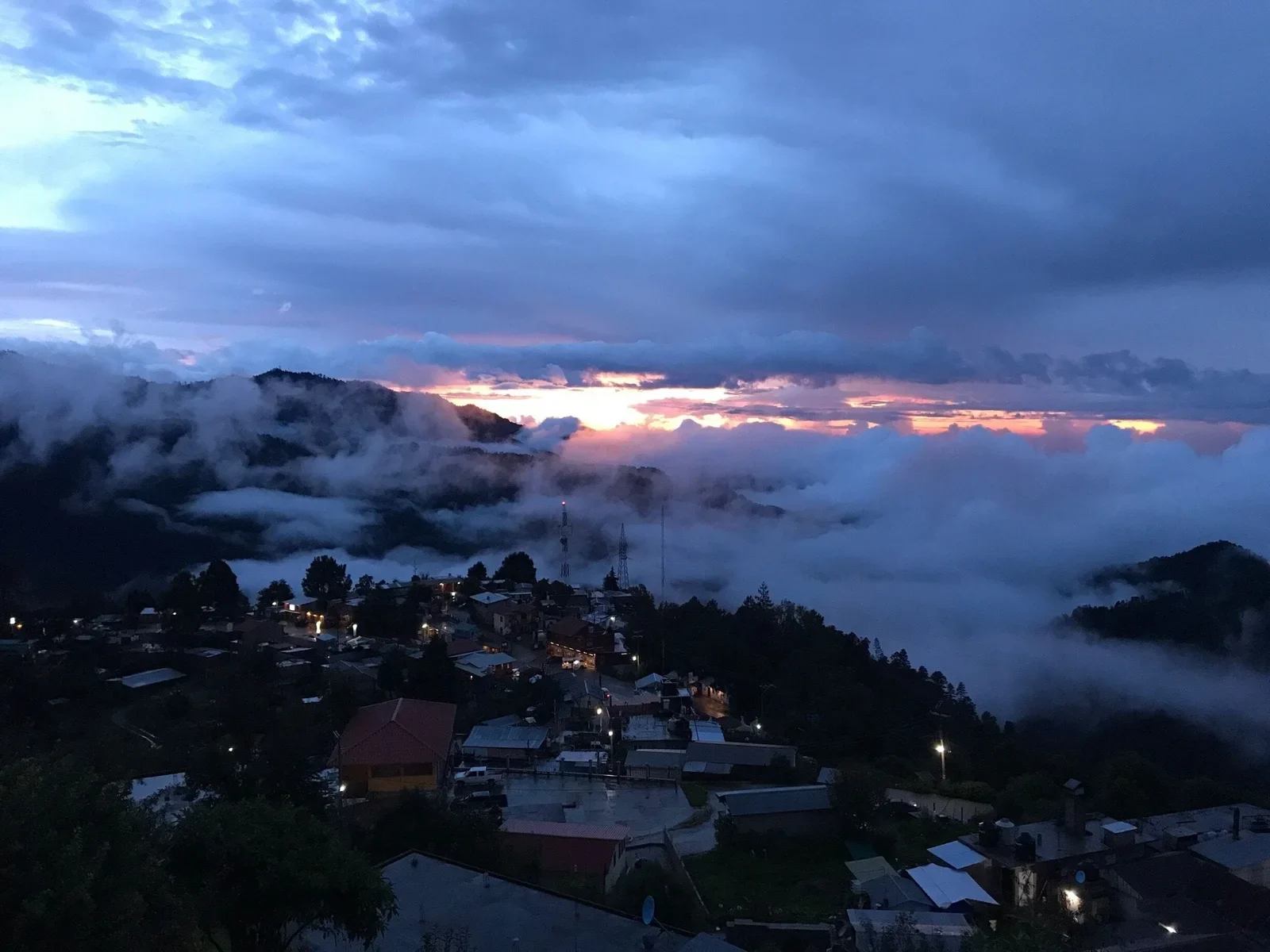
Sunset at San José del Pacífico
Illustrative image / not the author's property.
Hammock with cloud sea view in San José del Pacífico
July 31 to August 2, 2026 in San Mateo Río Hondo, Sierra Sur, Oaxaca, Mexico.
Is there an ATM in San Mateo?
No. The nearest is in San José del Pacífico (not always working) or in Miahuatlán. Bring enough cash for your entire stay before heading up.
Is there cell service?
Very limited or none. Some accommodations have basic WiFi. Let people know you'll be off the grid before you leave.
Do I need to book accommodation in advance?
Yes, especially during the festival. San Mateo has very limited options; San José del Pacífico (10 km) has more variety and works well as an alternative base.
Are magic mushrooms legal in Mexico?
It's a legal gray zone. Mexico's General Health Law classifies psilocybin as a prohibited substance. Traditional ceremonial use in indigenous communities is culturally tolerated — not legalized. As a foreign visitor, understand the distinction and the risks before you decide.
Can I go without speaking Spanish?
Yes, but with more friction. Festival guides and local operators work primarily in Spanish (and in some cases, Zapotec). If you don't speak Spanish, bring someone who does, or be prepared for a more immersive language experience.
What should I pack?
A warm jacket or fleece, a rain layer, comfortable shoes for dirt trails, enough cash for the whole trip, a headlamp, snacks, and — if you plan to consume anything — the right company.
What's the difference between San Mateo Río Hondo and San José del Pacífico?
San Mateo is the village hosting the festival — smaller, more community-centered, deeper in the sierra. San José sits on the main highway, has more tourist infrastructure, and is easier to reach. They're 10 km apart and complement each other well.
✦
The Bottom Line
The Mushroom Festival doesn't need to be sold as a mystical experience to be worth your time. It's worth it because a Zapotec community in the Oaxacan Sierra is opening its forests, its food, and its traditions for three days — with real people behind every activity. Go, learn, enjoy the forest, spend your money with the community. And if the mushroom takes you somewhere, let it be with respect and care.
Have questions about Oaxaca? There's a Facebook community group where you can ask — most members speak Spanish but there's always someone bilingual happy to help. Qué Onda Oaxaca — community & links.
✦
Was this guide helpful?
This is an independent project — no algorithms, no VC money, just research, boots on the ground, and a genuine love for Oaxaca. If this guide saved you time, a headache, or just came in handy, consider supporting the project with a coffee. It goes directly here.
☕ Buy me a coffee