Basketball: The King of Sports in the Sierra Norte de Oaxaca | Oaxaca Blog · Qué Onda Oaxaca
Publicidad
Foto: Jorge Santiago
Article9 min readAugust 26, 2026
Basketball: The King of Sports in the Sierra Norte de Oaxaca
In the Sierra Mixe and Sierra Norte of Oaxaca, afternoons don't revolve around a soccer field but a basketball court. The story behind why.
By
mish Dary
Director · Qué Onda Oaxaca
9 min
Centauros de Juquila, Copa Mixe champions in 1970. Photo: Centauros de Juquila archive
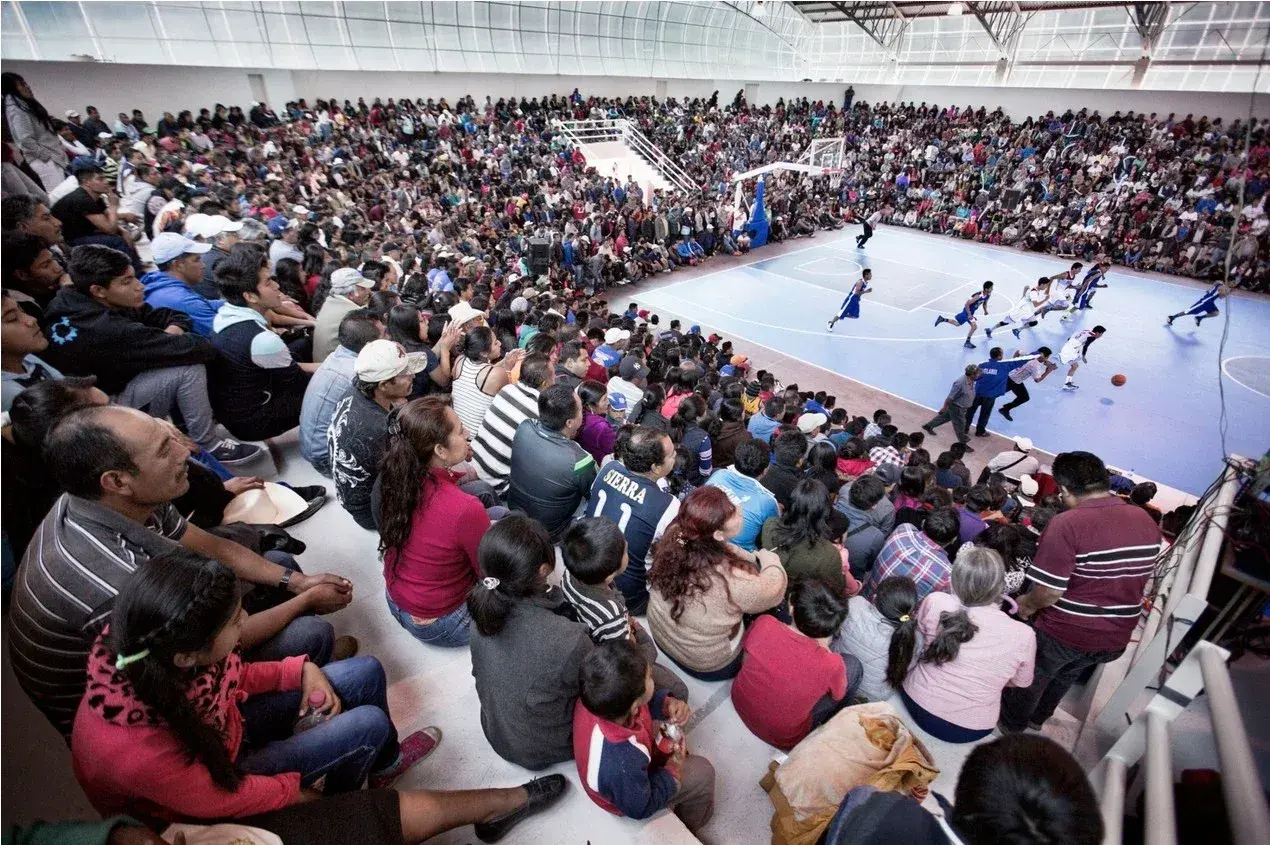
In the Sierra Mixe and much of the Sierra Norte of Oaxaca, afternoons don't revolve around a soccer field — they revolve around a basketball court. I grew up inside this world without fully understanding what it represented, until I left my hometown and started asking questions.
My hometown ran on the court's schedule
Growing up, I watched the entire town gather every afternoon to play basketball. It wasn't just a pastime: there were known figures, local celebrities of a sort, and the name that came up constantly was the Centauros de Juquila team. Some of my friends would get showered with praise just for being the sons of great basketball players — that's how seriously people took this.
Over time, my mom told me something I didn't expect: that my dad, as a young man, used to travel from town to town playing basketball with his coworkers. It surprised me, because my father was always a reserved person. He rarely shared memories from his youth, and the ones he did share were almost always about hardship — about growing up in a small village and coming to the city of Oaxaca to study, a time full of pain and racism that he preferred not to revisit. But this was different. It showed another side of him — one where there was also fun, camaraderie, and new places to visit.
I grew up surrounded by basketball and people even tried to get me into it — it didn't take — but honestly I wasn't fully aware of what it all meant until I left. That's when I started noticing the exact same thing happening in every other town in the region.
Coca-Cola and a court: the two things that were always there
At some point in my adolescence I wanted to become a priest, so I studied at religious schools. That meant we spent every Sunday as missionaries in distant Oaxacan villages, traveling with classmates. These were communities with real hardships — there's no point pretending otherwise — but there were two things that were never missing in any village, no matter how remote: a basketball court, and a Coca-Cola.
View of the main basketball court in Las Peñas Tamazulapam, April 2017. Photo: Jorge Santiago
That image stayed with me, and years later — with more curiosity than nostalgia — I started reading about it. Here's what I found.
Not a coincidence: the mountain decided
The first thing you discover when you research this is also the most practical, least romantic explanation of all: the Sierra Norte of Oaxaca is, literally, a sierra. Hillsides, terraces, rugged terrain. Building a basketball court — which takes up a fraction of the space a regulation soccer field requires — is actually feasible in places where putting in a full soccer pitch simply isn't. The landscape chose the sport before anyone else did.
A "pacification" policy that got out of hand
This is where the story gets more interesting. There's no exact date for when basketball first took hold in the sierra, but a version of events that keeps coming up among those who've documented this for years goes like this: in the late 1930s, during the Cardenista era, the Mexican government pushed basketball in indigenous communities as part of a strategy to integrate — or, as photojournalist Alicia Vera, who has spent years photographing this world, describes it, literally pacify — indigenous peoples with a long history of land disputes and resistance to centralized power.
The government's play was simple: if you can't resolve a land conflict, give people something else to compete for.
What no one in Mexico City calculated was that the game would slip out of their hands. It stopped being state policy and became village identity. Ours.
The Copa Benito Juárez and the Copa Mixe: the two great sierra tournaments
If there's one event that captures all of this, it's the Copa Benito Juárez, hosted in Guelatao de Juárez, played every year in the weeks leading up to March 21st. According to the accounts I found, the tournament started in the mid-1970s — meaning it's approaching half a century of history. The prize is a silver trophy valued at over 80,000 pesos, and the rule that gives it all its symbolic weight is this: the winning team takes the trophy home to display for a year, but then must return it to be contested again. Only a team that wins three times gets to keep the trophy permanently.
A player concentrates at the free-throw line during the final games of the Copa Benito Juárez. Guelatao de Juárez, March 21, 2016. Photo: Jorge SantiagoFinal of the Copa Benito Juárez between Ixtlán and Santiago Zacatepec. Guelatao de Juárez, March 21, 2013. Photo: Jorge Santiago
At the heart of the Sierra Mixe is its own classic: the Copa Mixe, the most important tournament specifically for our region, with teams from Tlahuitoltepec, Zacatepec, Ayutla, Totontepec, Tamazulápam, and my own hometown — San Juan Juquila Mixes. Like almost everything in the sierra, it's synchronized with the patron saint feast calendar — basketball, nature, and the mayordomía system have shared dates for generations.
Sofía Robles, Tlahuitoltepec's first female mayor, takes the opening shot at the basketball tournament. Santa María Tlahuitoltepec, May 19, 2012. Photo: Jorge SantiagoCentauros de Juquila in 2019, champions once again at the Copa Mixe in Tamazulapam. Photo: Centauros de Juquila archive
Playing even when you no longer live there
And this is what moved me most while researching: even people who no longer live in their village are still part of this. Every patron saint festival organizes a tournament, and a significant portion of the prize money is funded by migrants who have been in the United States for years — sometimes decades. It's their way of staying present in a place they often can't return to.
There's a case documented by photographer Jorge Santiago: a migrant living in California donated money for the first-place prize at his hometown's tournament but didn't risk crossing the border to deliver it himself. He sent his own children — small kids who had never set foot in Mexico — to hand over the prize in his name. That's how strong the bond runs. He keeps playing, even when he can no longer play.
Saúl Estrada Pablo, age 4, and Martín Estrada Pablo, age 6 — sons of Napoleón Estrada, a migrant living in Escondido, California. Both American-born, visiting Mexico for the first time. San Cristóbal Lachirioag, November 19, 2011. Photo: Jorge SantiagoVillagers bless the first-place basketball trophy in an early morning ceremony in San Cristóbal Lachirioag. November 21, 2009. Photo: Jorge Santiago
I didn't research this because I found something odd in someone else's text. I researched it because I wanted to understand something I lived through my entire childhood without ever naming it: why my hometown, and practically all of the Sierra Norte of Oaxaca, decided that soccer wasn't king. The answer has to do with mountains, with 1930s politics, with pride, and above all with people who left but never stopped betting on their community. That court — the same one where my friends played, the same one my father crossed as a young man without ever telling me — remains, to this day, the place where an entire people gathers to keep on being a people.
Some of the research and photographs in this article draw on the documentary work of Jorge Santiago and Alicia Vera, two photojournalists who have spent years documenting basketball in the villages of the Sierra Norte of Oaxaca. Their work is well worth exploring at focus.jorgesantiagophoto.com/basketball-oaxaca.
✦
Frequently asked questions
Why is basketball so popular in the Sierra Mixe and Sierra Norte of Oaxaca?
Two reasons combined: the rugged mountain terrain makes it far easier to build a basketball court than a regulation soccer field, and a late-1930s Mexican government policy that promoted basketball in indigenous communities as an integration strategy. Over time, basketball stopped being an imposition and became each village's own identity.
What is the Copa Benito Juárez?
It's the most representative basketball tournament in the Sierra Norte of Oaxaca, hosted in Guelatao de Juárez. It's played every year in the weeks before March 21st and awards a silver trophy that the winning team displays for a year before returning it to be contested again.
What is the Copa Mixe?
It's the most important basketball tournament specifically for the Mixe region (Sierra Mixe), with teams from villages including Tlahuitoltepec, Zacatepec, Ayutla, Juquila Mixes, and Totontepec — typically scheduled around each community's patron saint feast days.
Do migrants still participate in these traditions even when living outside Oaxaca?
Yes. It's common for migrants living in the United States to donate prize money for basketball tournaments held during their hometown's patron saint festivals, as a way of staying present in a community they often cannot physically return to.
✦
Got a story from your hometown? If you come from the sierra, the Valles Centrales, or anywhere in Oaxaca and want to share a story, curiosity, or tradition — write to us at mezcalspeaks@gmail.com. There's always room for your story here.
Want to advertise or promote something? You can do it in our Featured section. It's how we fund this project and keep creating content about Oaxaca.
✦
Want to read more stories and guides about Oaxacan culture? Visit our blog or check out the events guide for the season.
This is an independent community project. If you found value here, consider buying me a coffee — it keeps this going. Also: we have a tiny shop — t-shirts, mezcal & stuff.