




Making friends in Oaxaca is, honestly, relatively easy. The culture here is defined by hospitality and warmth — you'll feel it the moment you step outside, especially if you venture into the smaller towns. What Oaxaca has that most places don't is a deep sense of community, and that sense of community is rooted in two very concrete things: the tequio and the guelaguetza.
The Tequio and Guelaguetza: Why Connection Comes Naturally Here
The tequio is a system of collective, unpaid labor practiced in Oaxaca's indigenous communities for generations. When a town needs something — fixing a road, building a school, cleaning the cemetery before a celebration, constructing the church, or preparing the grounds for a festival — residents organize and contribute their work without being paid. It's not charity, and it's not volunteerism in the way we usually understand it outside Mexico. It's a communal obligation that is also a privilege: everyone gives because everyone receives.
The guelaguetza works similarly but on a more personal level. It's a reciprocity system where you support someone — with money, food, or labor — at an important moment like a wedding or a patron saint celebration, with the understanding that this person will do the same for you when your moment comes. Both tequio and guelaguetza are proof that in Oaxaca, community isn't a pretty Instagram concept — it's a way of surviving together. And that logic carries over, without anyone spelling it out, into the city's social life. Here people are more willing to include you, to invite you to share a beer, to introduce you to a friend, or take you to a village celebration as if they've known you their whole lives.
So in theory, making friends in Oaxaca is straightforward. Just walk into a café, join a calenda, find a mezcalería, or — my personal favorite — show up to Txalaparta. But my story started being a lot less simple than that.
My Story: Coming Back to Oaxaca Without a Single Friend
I didn't grow up in Oaxaca City. I grew up in a small town, then left for boarding schools and universities outside the state, and ended up working as an engineer in Querétaro and Guadalajara. When I finally decided to come back and settle in Atzompa, I realized something I hadn't expected: I had no friends here. Childhood friends had all moved on — everyone scattered in their own direction or already settled into their lives — and I arrived feeling practically like a stranger in my own land.
Add to that: I'm introverted by nature, though over the years — and out of necessity — I developed social skills I didn't have before. And I'm also a closet nerd, so my first attempts at building community definitely had that stamp. I tried a lot of things. Some worked better than others. I'm sharing all of them here — whether you're a local who's been in the same boat, an expat, or someone just passing through the city.
Where to Meet People in Oaxaca: What Actually Worked for Me
Film Clubs, for Those Who Are Into Cinema
If you like film, this is one of the most organic ways to meet people who share your sensibility. I started going to Sala Elia, which screens independent cinema for around 50 pesos — and some days even for free (check their location here). You'll always run into genuine film lovers there.

Sala Elia — screenings from $50 MXN, some days free.
But my favorite, with no competition, is Cineclub Punto 113 (location). Fair warning: the selection is genuinely excellent, and many regulars are serious cinephiles — quite a few international visitors — so the conversation after the screening tends to be a real mix of locals and people from elsewhere, all ages. It's a carpentry workshop by day that transforms into an improvised little cinema some evenings. You can bring your own beer or mezcal to share. It's free and, honestly, one of the friendliest communities I've found in the city.
Txalaparta, the Classic
I have to mention Txalaparta — what I jokingly call the "backside of Oaxaca." You'll find all kinds of people there, but you need to bring initiative. If you're extroverted you'll do great; if you can dance, even better; and if you're like me, a couple of mezcals to loosen up the steps and you're set.
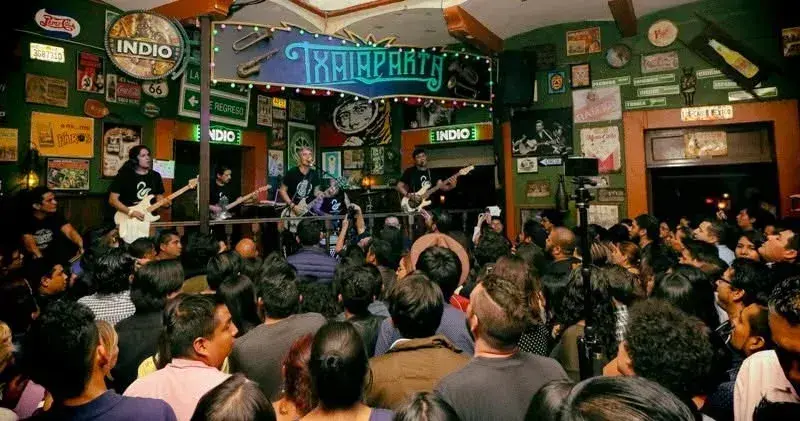
Txalaparta — where most Oaxaca nights eventually end.
A tip: everyone wants to be on the rooftop terrace Thursday through Saturday, and the line can be a real ordeal. I suspect it's mainly because it's open air, not so much because of the DJ. I actually prefer downstairs — depending on the night there's live music, and for me that's the best part. Fair warning though: it has some of the worst bathrooms in the city.
Salsa and Latin Dance Classes
I signed up for salsa classes because not knowing how to dance and wanting to meet people felt like reason enough — and it worked on both fronts, just not equally well. For meeting people, they're excellent: there's a lot of social energy and people tend to organize outings to salsa events around the city. For actually learning to dance, I have my reservations — in my experience the classes tend to stay stuck recycling the same basic steps, which gets dull over time. But there's no doubt it's a great place to meet passionate people, and yeah, this could be where you find your summer romance. LOL. Check our events calendar for updated dates. Some collectives organizing these are La Clave and Salsa Guateque Oaxaca, at different venues around the city.
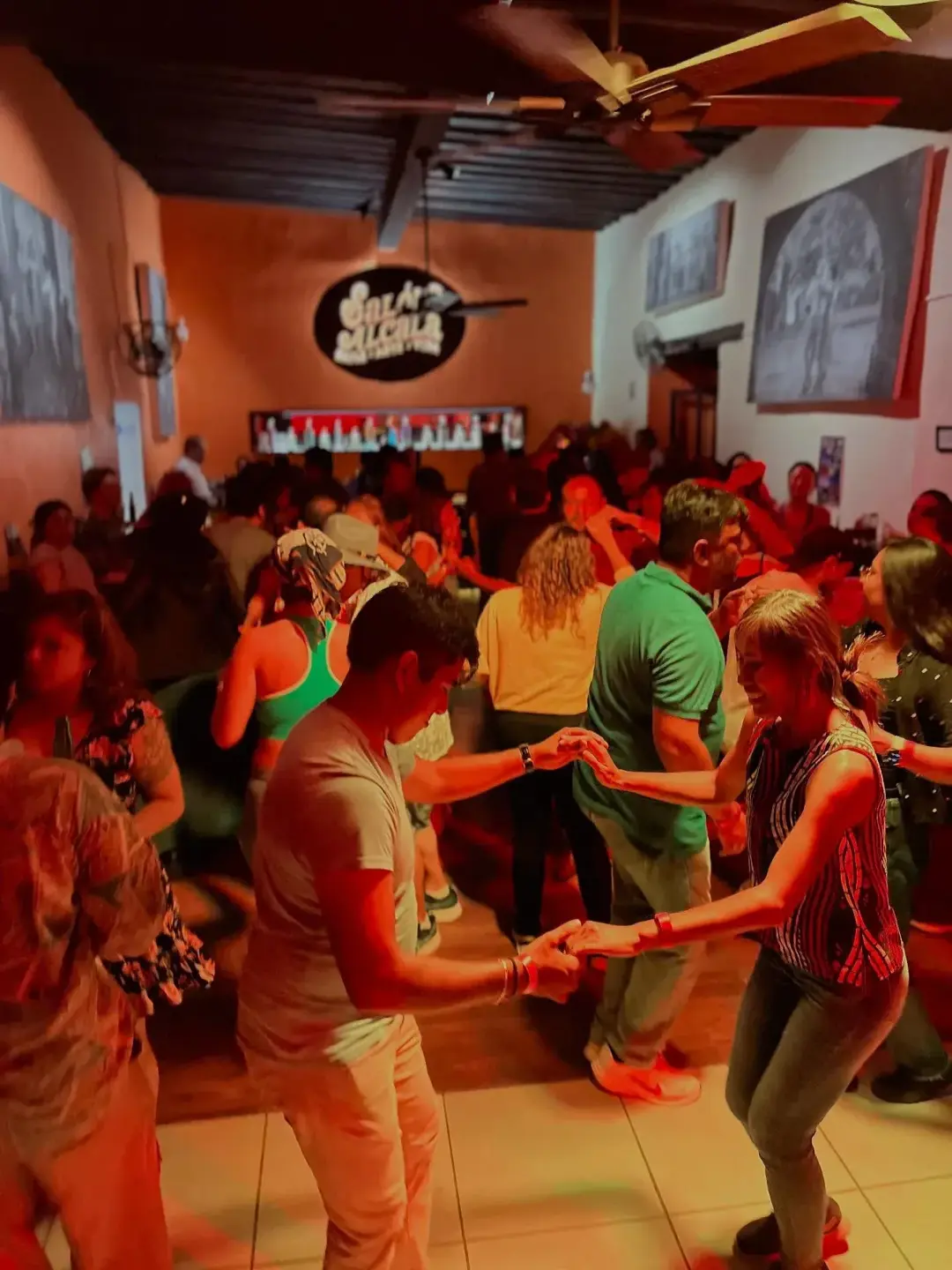
Guateque Colectivo at Salón Alcalá.
Bike Tours with Mundo Ceiba
I also joined the bike tours organized by Mundo Ceiba — check their availability since they're not always at night. It's great exercise and you tend to connect with people naturally while pedaling through the city to the sound of music. You can bring your own bike or rent one for around 150 pesos (~$7 USD); they'll ask for ID.
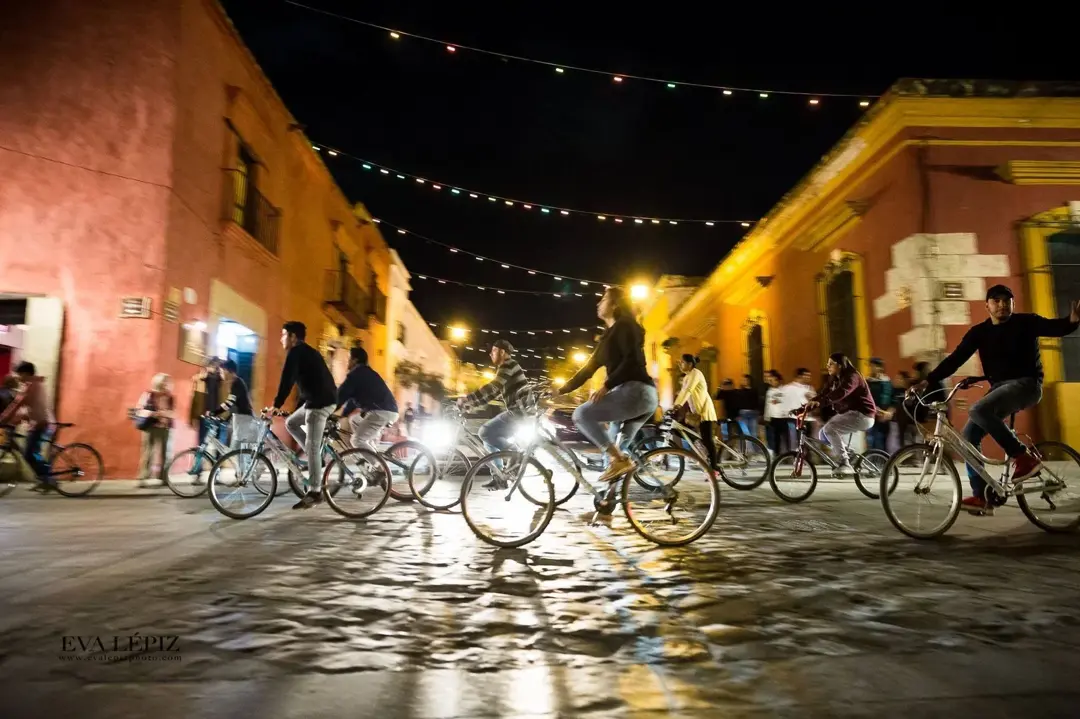
A night ride with Mundo Ceiba.
Photography Walks and Workshops
Not always available, but when they are, they've been some of my favorite activities for meeting people with overlapping interests. The folks at La Comuna Análoga have put together some photography walks worth following. The Centro Fotográfico Manuel Álvarez Bravo also organizes digital photography walks around the city. Follow both accounts and check their schedules.
Do Tinder and Bumble Work for Making Friends in Oaxaca?
I tried both. I genuinely wanted to make friends, and had moderate success. The unspoken rule of those apps is that they're for dating, which is fine, but it feels too superficial for me as a friend-finding tool. There's also something I kept running into that I want to name: a fair number of foreigners use them to match with locals and essentially get free private tour guides of the city. I've thought about it a lot and my take is simple: don't do that. It's not ethical.
Couchsurfing and Free Group Tours
Couchsurfing exists, and has a Hangouts feature that's technically for meeting people without anyone having to host anyone. I've used it and it works — sort of. My observation is that in Oaxaca, most active users are foreigners or travelers passing through, so if you're looking to mix with a more diverse community, it can feel a bit limited. Not bad, but not the first thing I'd recommend to someone trying to put down roots here.
If what you want is to meet all kinds of people — locals and visitors alike, and without spending money — nothing beats a free group tour. The bike tour to El Tule, Historic Center, and Zócalo starts at the Basílica de la Soledad, pedals out to Santa María del Tule — about 11 km — stops at the artisan market, and winds back through the Zócalo and the tourist walkway. A few hours in motion with people who, by definition, already have something in common with you: curiosity. The free tour through the Jalatlaco neighborhood is the walking version, ideal if you'd rather explore murals and art workshops on the city's most picturesque streets. Both are pay-what-you-want, so the only excuse that doesn't apply is money.
This article contains affiliate links. If you book or hire through them, I earn a small commission at no extra cost to you. Thanks for supporting Qué Onda Oaxaca.
The Oaxaca Language Exchange: How It Started and Why I Keep It Going
Like a lot of people, coming out of the pandemic I wanted to improve my English — especially with the remote-work boom happening. I tried book clubs, film clubs, and eventually found the Oaxaca Language Exchange, which I loved from the first time. That's where I met some of my first real friends in Oaxaca, and eventually enough of them that I ended up organizing it myself.

Convivio — where the language exchange I now run as @luditalk began.

Kunt Vargas at Convivio. Great memories from that place.
It originally happened at Convivio, a place I loved because after practicing languages it would turn into a full night out with live music and DJs. I have a lot of good memories there, and a few stories I'll keep to myself. Convivio closed, and the people who started it — Alex and Parker — left the city. I decided to keep it going with the same spirit, and for the past couple of years I've been organizing it as @luditalk.
It's still free and accessible — especially thinking about those of us who are local, because with everything happening in Oaxaca right now, there are spaces and activities that shouldn't be as hard to access for people who actually live here. I try to find deals so everyone can enjoy it. The location, day, and time have shifted over the years, but right now I run it:
- ▸Wednesdays at Océano Show and Drinks (location here)
- ▸Thursdays at Wombat (location here)
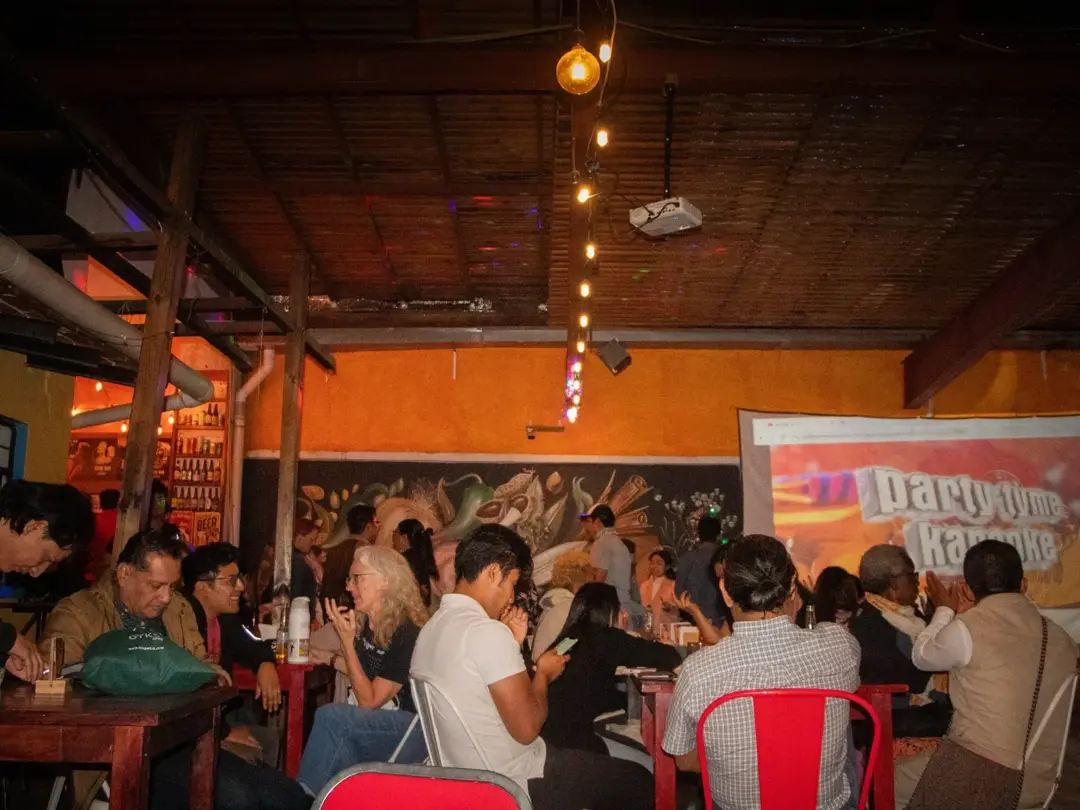
Luditalk in action — the weekly language exchange I organize.
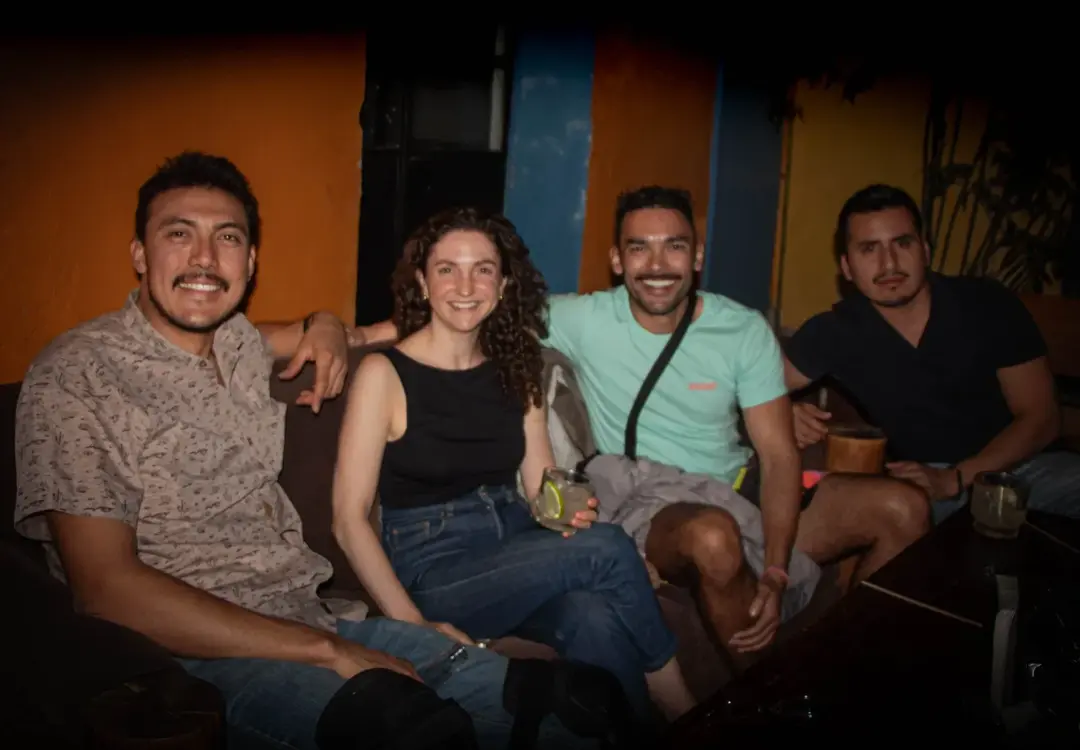
A relaxed, inclusive space where the only agenda is connection.
I've met countless people there that I'm still in touch with, and others the distance eventually took — locals and internationals alike, in a relaxed and inclusive atmosphere. That's been the vision from the start: a no-pretension space where the only thing that matters is connection. We try to make it a safe space, especially for women, and building that has cost me arguments, friction, and a couple of cancellations. Worth it every time.
If you want to join this kind of group or find others like hiking clubs and community projects, check queondaoaxaca.com/links — you'll find several communities organized by activity where you can ask whatever you need.
We also organize trivia nights occasionally, and I'm starting to put together group outings for people who want to go dancing, do a street food crawl, or just grab drinks. The idea is always the same: build community. Nothing snobby, nothing trying to be a clique. Everyone's welcome.
I Like to Eat and Make Friends: Night Food Tours in Oaxaca
As a proper Oaxacan, I deeply believe the best place to meet people is around food. And Oaxaca's nighttime street food scene is, frankly, one of the most powerful social lubricants there is. If you're more of a night person, the Oaxaca night street food tour is one of the best dynamics I know for breaking the ice with strangers while eating well: they take you by van to the places locals actually eat — not the curated tasting-menu kind — you watch families preparing dishes with techniques passed down for generations, you learn the history and cultural roots behind the food, and you end up talking with the rest of the group over tacos and tlayudas. That breaks any social barrier without much effort.
If you'd prefer something with a little more movement and mezcal included, there's also the tacos, mezcal & music tour in Oaxaca, which combines the three best social lubricants Oaxaca has to offer. I'm not the first one to say it.
Looking for Something More Structured? Oaxaca Lending Library
If you'd rather practice languages in a more serious, structured environment, I recommend the Oaxaca Lending Library. I attended a couple of years ago and I'm still genuinely grateful for the help and patience they gave me.
Building Community Also Means Giving: Volunteering in Oaxaca
If volunteer work is your thing, it's also a meaningful and great way to meet people. I personally recommend the community kitchen Nkä'äymyujkëmë, which in Ayuujk — my language — means "let's eat together." They feed people experiencing homelessness, activists, and migrants at no cost. They accept donations and volunteers. And maybe there, where you least expect it and where most people never go, you'll find something too.
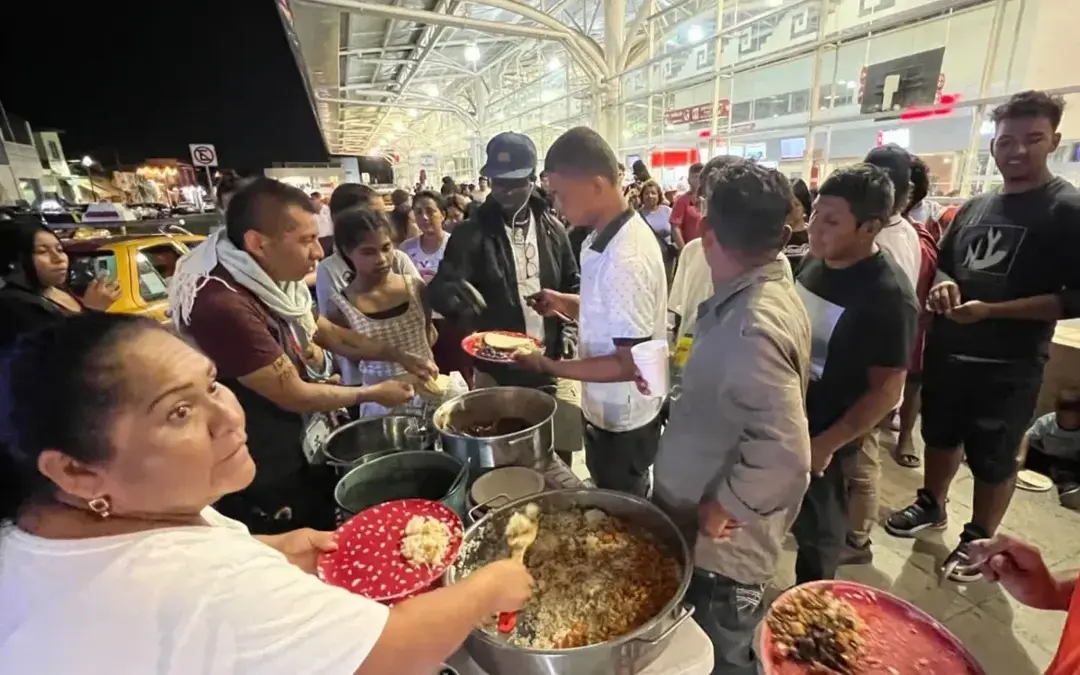
The ayuujk community kitchen feeds migrants and people in need arriving in Oaxaca — free of charge.
To Close
Making friends in Oaxaca as an adult isn't that different from making them anywhere else: it's about showing up, even when it feels like too much effort or makes you anxious, and giving the spaces that already exist a real chance before assuming there's nothing here for you. There's plenty of community — cinephile, linguistic, cycling, and solidarity-based. You just have to be willing to appear. And something very important I have to say from personal experience: Oaxaca's warmth and hospitality have made it a target for people from more individualistic cultures who come to take without giving back. It's not only about receiving — it's about contributing to the community. Keep that in mind.
Getting around the city without overpaying: Complete Oaxaca transportation guide
Is Oaxaca safe? Read our safety guide
Was this guide helpful?
This is an independent project — no algorithms, no investors, just research, miles covered, and genuine love for Oaxaca. If this guide saved you time, a headache, or just came in handy, consider supporting the project with a coffee. It goes directly here. ☕ Buy me a coffee
