

Cargando…
Cargando…
No favorites in Oaxaca yet.
Tap the heart on any event to save it.
October 31 – November 2 · Oaxaca de Juárez & the Central Valley
Day of the Dead in the city of Oaxaca and its central valleys is one of the most culturally dense and complex celebrations in all of Mexico. It's not a single night's event — it's a week of monumental altars, nighttime processions with brass bands, cemeteries lit by thousands of candles and marigolds, muerteadas that last until dawn in the Etla Valley villages, and families welcoming back their dead with black mole, mezcal, and the songs they loved in life. This guide is written from the inside, with the intention that your visit adds rather than takes away.
International perception usually presents Day of the Dead as an unaltered pre-Hispanic ritual more than three thousand years old. The actual history is more interesting than that.
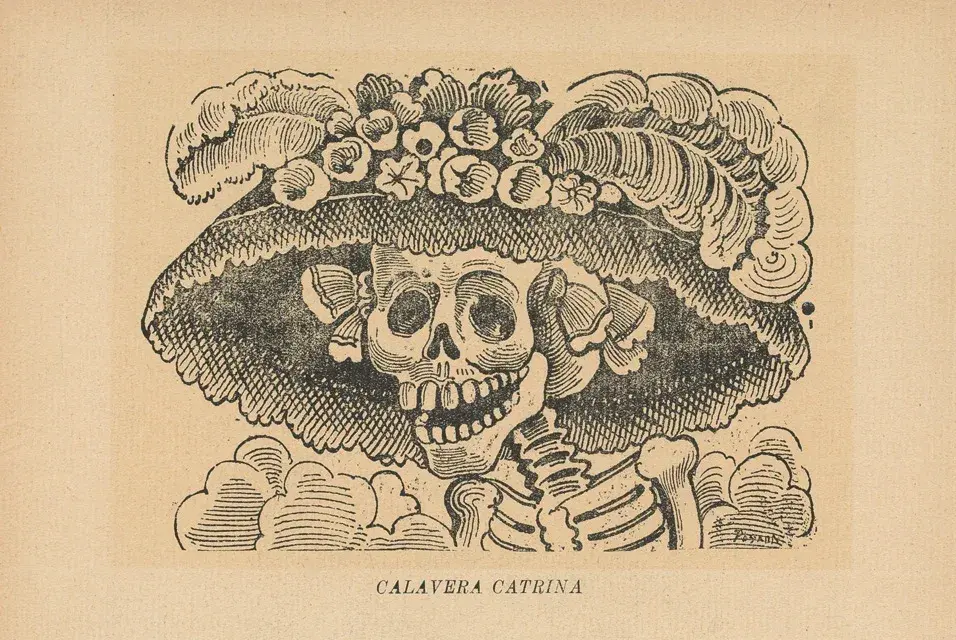
The visual imagery we associate with Day of the Dead was born in two distinct moments. The first came when political illustrator José Guadalupe Posada (1852–1913) created, around 1910–1913, a satirical cartoon titled La Calavera Garbancera — a female skull wearing an elaborate French-style feathered hat. It was a sharp critique of the Porfiriato elite: people of indigenous or mestizo origin who denied their roots, wore face powder to appear European, and pretended to aristocracy. The “garbancera” sold chickpeas at the market but posed as an aristocrat. Posada's message: beneath the imported hat, we are all the same skull. The 1913 broadside showed only the head — no body.
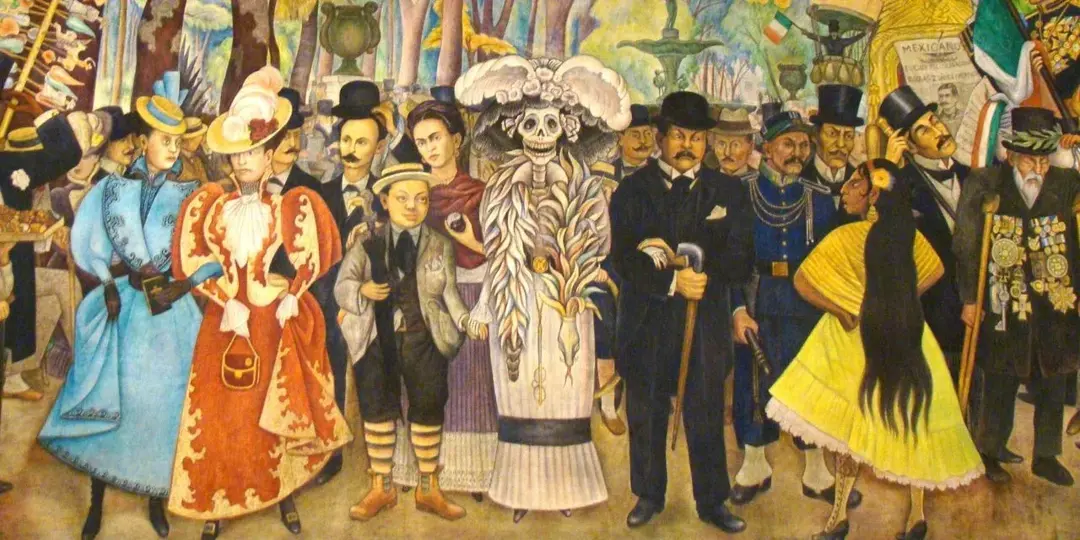
The second moment came in 1947, when Diego Rivera painted the mural Dream of a Sunday Afternoon in Alameda Central Park for Mexico City's Hotel del Prado (now housed in the Museo Mural Diego Rivera). Rivera took Posada's skull, drew a full body in Belle Époque dress, and named it for the first time “La Catrina” — from the Mexican slang catrin/catrina, meaning someone dressed with pretentious elegance. That is where the icon that now circles the globe was born.
Historian Elsa Malvido, who directed the Workshop on Death Studies at the INAH for over two decades, demonstrated in her work La festividad indígena dedicada a los muertos en México (CONACULTA, 2006) that the contemporary structure of the celebration was actively shaped by the post-revolutionary Mexican state. Under President Lázaro Cárdenas (1934–1940) — himself from Michoacán — the nationalist government sought to detach popular festivities from Church control by promoting a secular national identity rooted in indigenous and mestizo culture. Cárdenas found the colorful Purépecha altars of his homeland deeply attractive and financed their mass diffusion as “the definitive indigenous Mexican expression.” Intellectuals of the era fused the Catholic feasts of All Saints and All Souls — which already shared elements with universal European Catholic practice (bone-shaped breads, skull candies) — with Aztec cosmology and the cult of the goddess Mictecacihuatl. Traditions that had been intimate and domestic became totems of 20th-century cultural nationalism.
“The celebrations of All Saints and All Souls have been holy days in the Catholic world, but Mexican intellectuals turned them into Mexica and pre-Hispanic practices — and anthropologists have believed it.”
— Elsa Malvido, INAH · La festividad indígena dedicada a los muertos en México, CONACULTA, 2006
None of this means the tradition is fake or unworthy of celebration. It means it is alive: it was constructed, it adapted, and it keeps changing.
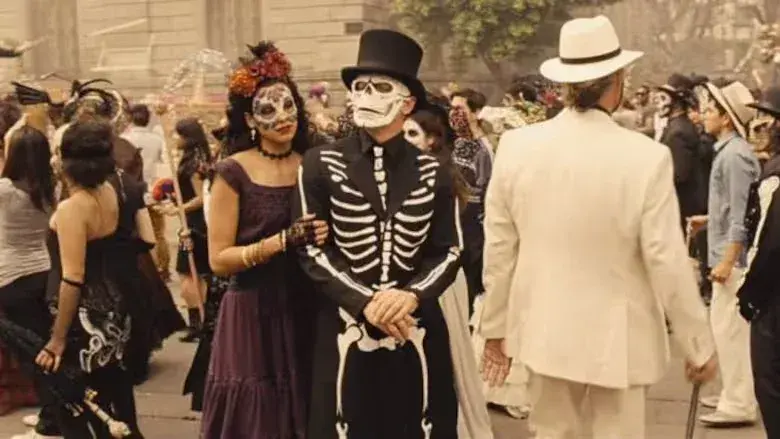
In 2015, the James Bond film Spectre (dir. Sam Mendes) opened with a massive Day of the Dead parade in Mexico City's Zócalo that had never existed before. Production filmed for 10 days in the historic downtown, forced the closure of large parts of the center, and cost more than 6,500 local businesses an estimated 375 million pesos in revenue. The following year, on October 29, 2016, Mexico City held its first-ever real Day of the Dead parade — explicitly modeled on the Bond film. In under a year, a “tradition” was born that thousands of tourists now seek out as authentic.
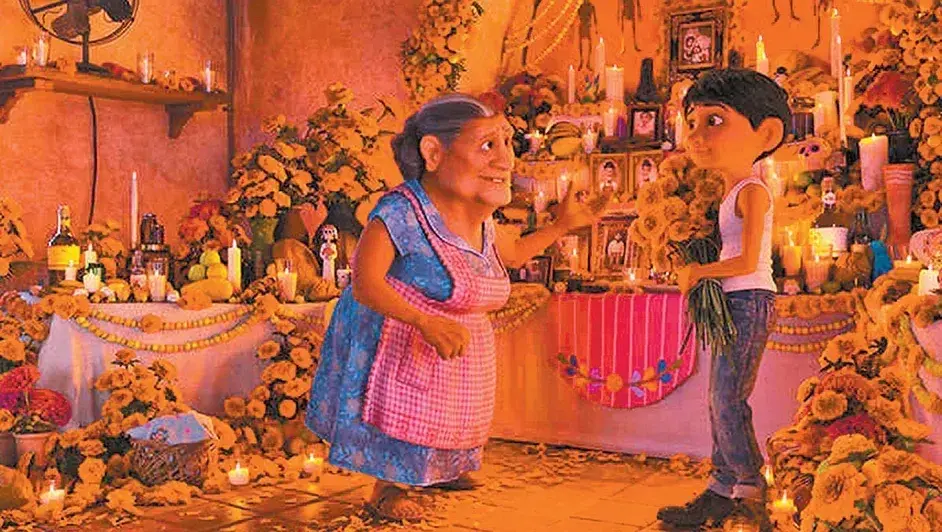
In 2013, before Coco was released, Disney filed to trademark the phrase “Día de los Muertos” with the USPTO, covering toys, cosmetics, jewelry and food. The backlash was immediate: over 21,000 people signed a Change.org petition, Mexican-American cartoonist Lalo Alcaraz went viral with a cartoon of a skeleton Mickey Mouse destroying a city, and Disney quietly withdrew the application. When Coco premiered in 2017, the Pixar team had conducted field research in Oaxaca (the fictional Rivera family was based on real Oaxacan families; co-director Adrian Molina confirmed that Monte Albán's stone architecture shaped the lower levels of the Land of the Dead), Michoacán (Santa Fe de la Laguna, Janitzio, Pátzcuaro), Guanajuato and San Andrés Mixquic, CDMX.
The result of all this is that today Day of the Dead is simultaneously a deeply rooted family tradition, a massive tourism event, and a constant negotiation between the sacred and the spectacular. Every visit you make is part of that negotiation.
Your choice of neighborhood determines your experience. There is no perfect zone — only zones based on what you want. Book at least 3-4 months in advance — Day of the Dead is the most in-demand season in Oaxaca, busier than even the Guelaguetza.
| Neighborhood | Profile | Best for |
|---|---|---|
| Historic Center | Heart of the action. Walking distance to comparsas, altars and cemeteries. High noise, extreme pedestrian crowds on key nights. | Travelers who want to be at the center of everything and sleep soundly. |
| Jalatlaco | Artistic pedestrian neighborhood, murals, vibrant but more manageable. Declared Barrio Mágico. | Photographers, solo travelers, those who want atmosphere without chaos. |
| Xochimilco | Artisanal heritage, peaceful and traditional. Close to the Center with quiet nights. | Families, early risers. |
| Reforma | 30-minute walk north of the Center. Modern residential hotels, low noise. | Business travel, families with young children. |
Oaxaca's cemeteries during Day of the Dead are not silent spaces of grief — they become places of mystical celebration, live music and communal reunion. Knowing the character of each one is key to planning efficient, respectful visits.
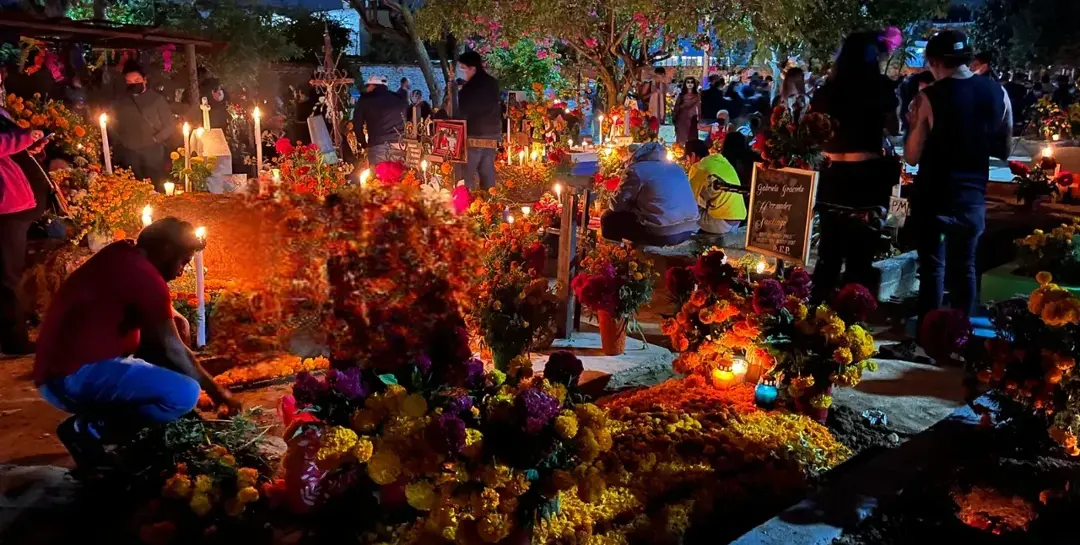
| Cemetery | Location / Profile | Hours (reference) | Notes |
|---|---|---|---|
| Panteón General San Miguel | Historic Center. Monumental architecture and high heritage significance. | 07:00 – 22:00 h (Nov 1-2, ref. 2024) | Restored in 2024 with 32 million MXN after 2017 earthquake damage. Formally reopened November 9, 2024. Nov 1 at 6 PM: Fauré Requiem concert. Street food and games outside. |
| Panteón de Xochimilco | Xochimilco neighborhood. Small community cemetery, traditional and calm. | Approx. 07:00 – 18:00 h (verify before visiting) | Ideal for quiet morning visits. Neighborhood atmosphere. Confirm hours with the municipality each year. |
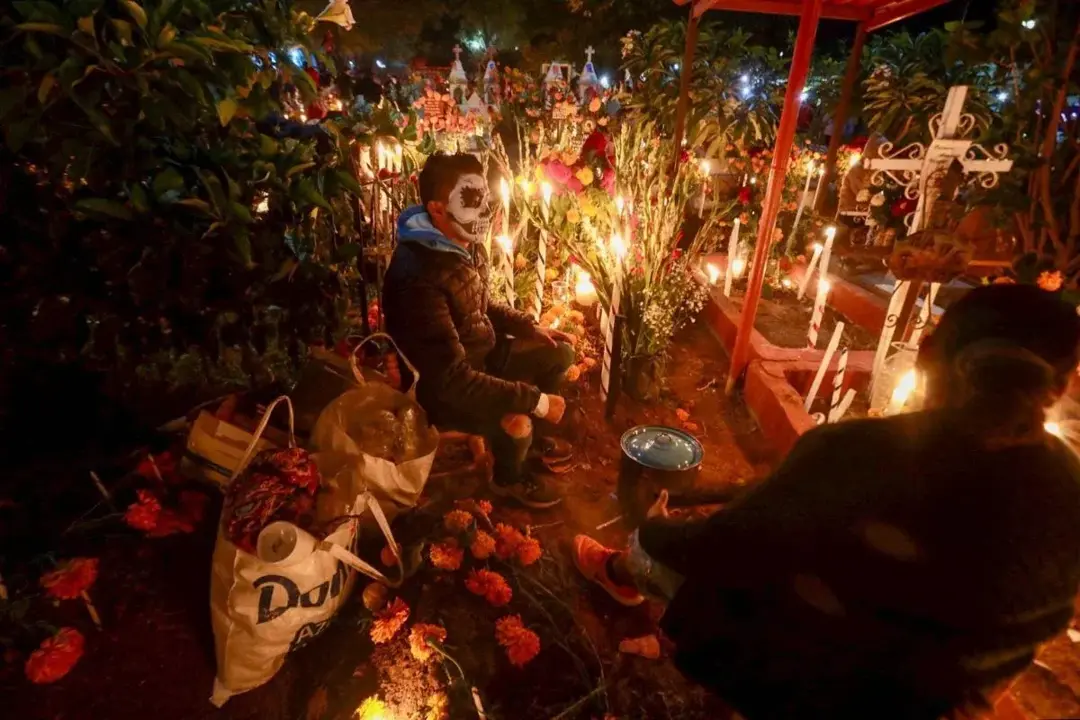
| Panteón de San Felipe del Agua | San Felipe del Agua, north of the city. Intimate and communal celebration. | Open from the afternoon of October 31 | Local accounts say only people from the village or with family ties can be buried here (community governance). There's always music and people may invite you to share a mezcal. Maximum respect. |
| Panteón Jardín | Urban buffer zone. Modern cemetery with ample green space. | To be confirmed | Less touristy. Ideal for observing local ofrenda rituals without crowds. |
| Panteón del Marquesado | Marquesado neighborhood, west side of the city. Small traditional cemetery. | Approx. 07:00 – 18:00 h | Good for brief daytime visits, easy access from western roads. |
| Panteón de Santa Cruz Xoxocotlán | Municipality of Xoxocotlán (outside the city). Most visited by tourists. | 07:00 h – late, night of Nov 1 | The most commercialized and crowded cemetery. Legitimate but very different from community cemeteries. |
Exact hours change each year and are set by the municipality. Verify before visiting at oaxaca.gob.mx or call the Unidad de Panteones: Carretera Antigua a Monte Albán No. 105, colonia La Fundición, San Martín Mexicapam.
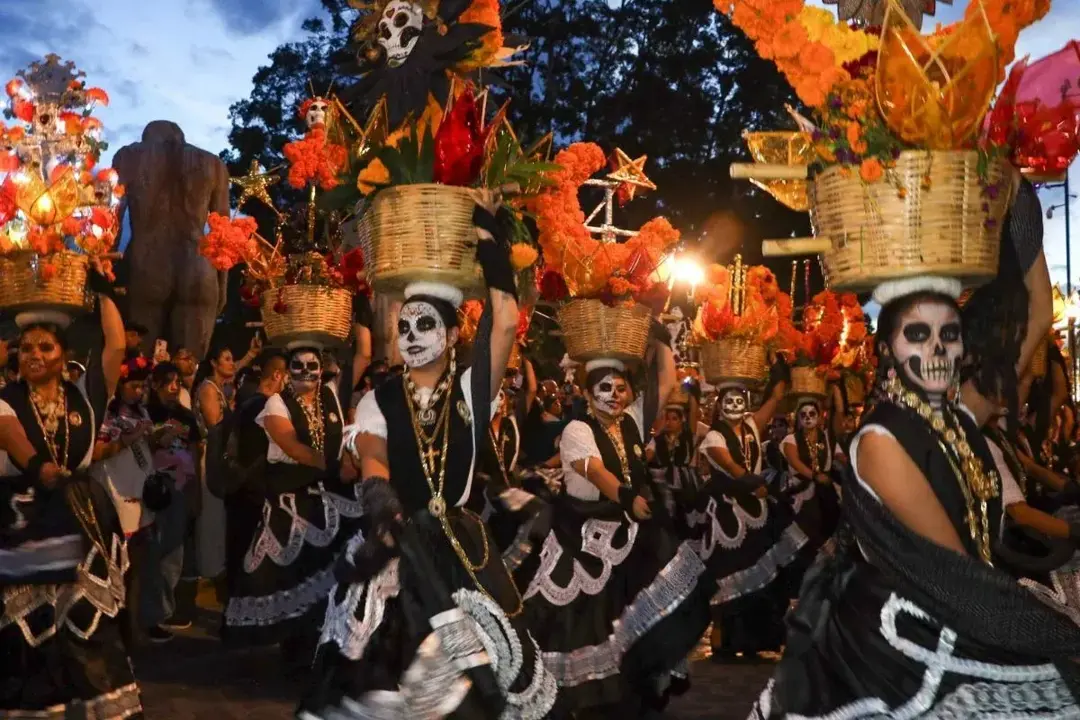
Oaxaca city's comparsas are festive nighttime processions rooted in colonial calendas — religious parades that announced each neighborhood's patron saint feast. Over centuries, they fused with indigenous funerary customs to create something unique: a nighttime caravan of costumed participants, brass band music and popular humor winding through the historic center.
The Comparsa de Cinco Señores (Barrio del Polvo) is considered the city's oldest. Those of Jalatlaco, Trinidad de las Huertas, Santa Lucía del Camino and Xochimilco are also key references. The municipality also organizes a Gran Comparsa that consolidates elements from multiple neighborhoods into a mega-procession through the historic center.
Comparsas are open and free to attend. Andador Macedonio Alcalá and the streets of the Centro fill on the nights of October 31 and November 1. Mojigangas — giant papier-mâché figures representing characters, deceased people or political caricatures — are a central part of the street spectacle.
In contrast to the urban festive spirit, the muerteada of the Etla Valley is a living tradition of community resistance and social satire with more than 80 years of organized history. It is celebrated intensely November 1-2 in San Agustín Etla (the cradle of the muerteada), Villa de Etla, San Pablo Etla, Soledad Etla, Nazareno Etla and San Sebastián Etla, among others.
The muerteada is a structured satirical theatrical performance — called La Relación — that parodies authority figures: the doctor, the priest, the judge, the devil and death. The central narrative: a dead landowner summons help; doctor and priest fail; the spiritualist/witch succeeds; the devil tries to steal the soul; ultimately the widow is left in the caporal's care. It is social satire with centuries of depth.
Devil costumes are emblematic: waistcoats and pants covered in thousands of hand-sewn metal bells, carved masks, bones and cattle horns — recently upgraded with lights, smoke and pyrotechnics. A costume can weigh 30-50 kg and represent a personal investment of 8,000 to 30,000 MXN or more. Participants carry them all night, sustained by mezcal, shrimp broth and pan de muerto offered by families along the route.
The brass bands are the sonic heart. Among the most active in the Etla Valley: Banda Puro Santa Rosa and Banda Misteriosa (active in the 2023-2024 circuit). The procession in San Agustín Etla starts around 10 PM on November 1; groups from different neighborhoods converge at 9:30 AM on November 2 for the closing. The experience lasts all night.
In November 2020, a vehicle driven by intoxicated people rammed the San Agustín Etla procession, injuring at least five people. The incident accelerated a regulatory process already under discussion due to tourist overreach affecting the sacred and communal character of the tradition. From 2022, San Agustín Etla (the most visited community) implemented strict rules:
Communities of Villa de Etla, Soledad Etla and San Pablo Etla maintain a more open and less commercialized character — though this may change.
Critical mobility advice for Etla
Before painting your face like a skull, it's worth knowing what La Catrina is and where she comes from. Posada drew her in 1913 as a critique of elites who denied their roots. Rivera gave her a body and a name in 1947. Her global adoption as the symbol of Day of the Dead is a 20th-century phenomenon, not an ancient pre-Hispanic continuity. Knowing this doesn't make the celebration less valid — it makes it more interesting.
It's not the end of the world. It's also not universal.
At the Historic Center, urban comparsas, artistic events, and the Panteón de Xoxocotlán, Catrina face paint is completely in tone: festive, open spaces where locals, tourists, and catrinas coexist freely.
The further you get from the city, the more the landscape shifts — not because it's bad, but because in many communities it simply isn't a custom. Face paint carries a more festive, performative connotation; in the more intimate valley cemeteries — San Felipe del Agua, Santa María Atzompa, Teotitlán del Valle — families, especially older adults, tend to hold vigil with quiet prayer and offering, not costume. You won't be asked to leave, but you may get a few puzzled looks — without ill intent, just because it's not done there. Younger generations are adopting it more and more. Things change. Being informed helps you read the context.
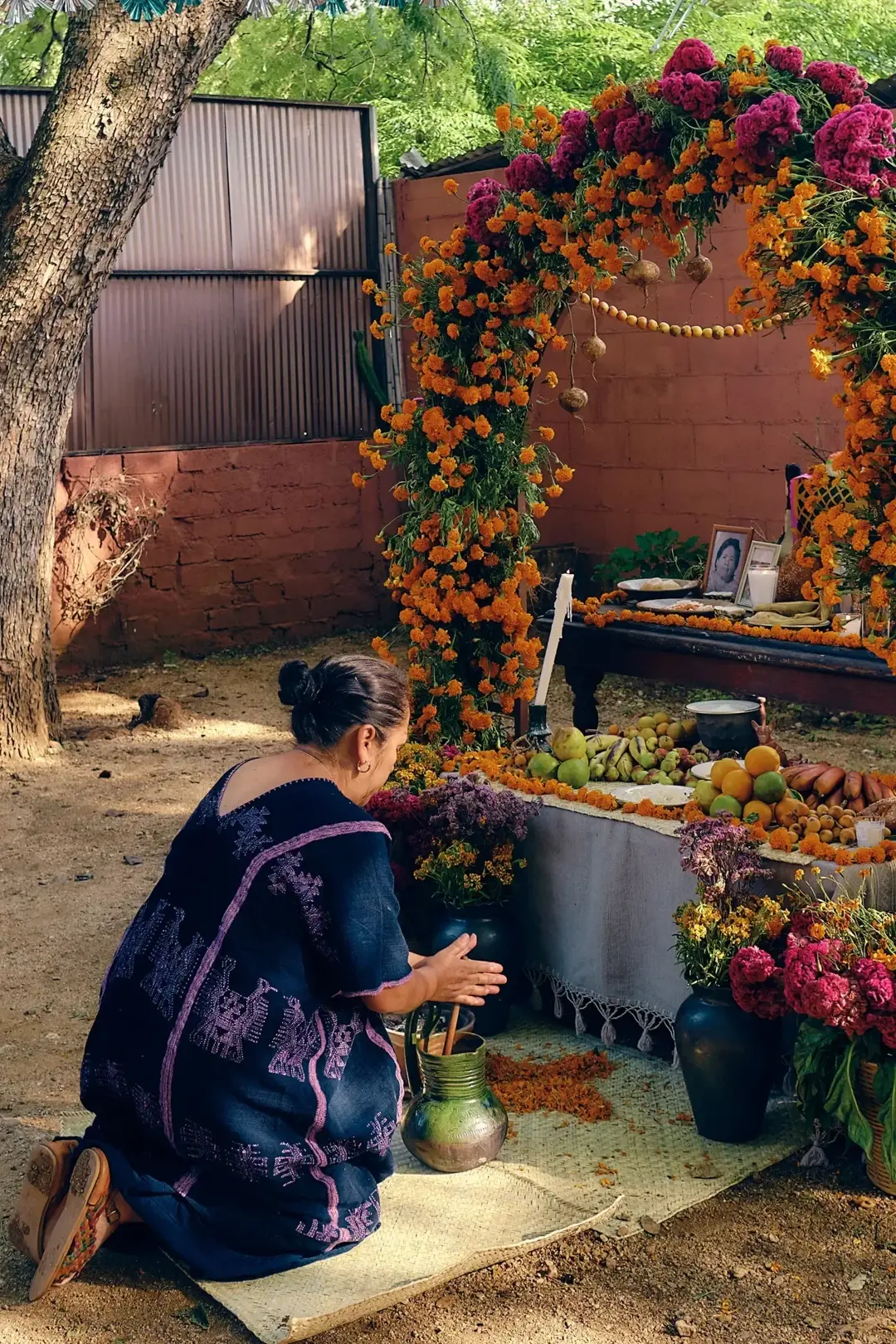
Day of the Dead gastronomy in Oaxaca is not a commercial menu — it is the physical representation of communion between the earthly plane and the beyond.
Mole Negro
The highest-ranking ritual dish. ~34 ingredients. Chiles partially charred, balanced with stone-ground chocolate, plantain, ginger, clove and toasted avocado leaf. The process can take days.
Pan de Yema with Chocolate de Agua
Oaxacan egg-butter bread decorated with hand-painted masa 'caritas' (little faces) honoring the deceased. Dipped into a bowl of cinnamon-spiced hot chocolate. Very different from Mexico City's sugar-and-anise pan de muerto.
Tamales de Mole in Banana Leaf
Fine seasoned masa filled with shredded meat in black mole, wrapped in roasted banana leaf and steamed. Available in markets and comedores from October 28 onward.
Calabaza en Tacha
Castilla pumpkin cooked slowly in a clay pot with piloncillo, cinnamon and spices until candied. Deep yellow, unrefined sweetness.
Tejate
Ancient pre-Hispanic drink of cacao, corn and mamey sapote. No sugar, no dairy. Find it cold at markets like the 20 de Noviembre.
Mezcal at the cemetery
In village cemeteries, mezcal is shared at the tomb as an act of communion. Toasts and fireworks at sunset on November 2 mark the departure of the souls. Not decoration — lay liturgy.
The Central Valley of Oaxaca is just one of the ways Day of the Dead is celebrated in the state. Every region, municipality and neighborhood has its own customs. Don't leave with only what one place showed you — Oaxaca is a microuniverse, and even communities in the same valley can be entirely different from each other.
Santa María Atzompa
Famous for green-glazed ceramics. The cemetery fills with candles and flowers from October 31. November 2: comparsa procession to the cemetery with the whole community.
Teotitlán del Valle
Zapotec weaving community. November 2 at sunset: mezcal toasts at the cemeteries, followed by fireworks and firecrackers to signal the souls' departure. Intimate and communal.
Zaachila
The Thursday before Day of the Dead: sand tapetes — colored sand carpets depicting death-related themes, sometimes representing how known community members died. Impressive and accessible for respectful visitors.
San Agustín Etla
The epicenter of theatrical tradition. The muerteada that defined the Etla Valley. See the muerteadas section for full details.

Most villages are 30-60 minutes from the Oaxaca city center by colectivo or taxi. Colectivos (minibuses with the destination marked) are the cheapest and most local option. For nighttime, negotiate a round-trip taxi.
The tipping debate in Oaxaca is real and has no single answer. Some argue it should be expected to compensate for labor precarity; others point out that excessive tourist tipping leads service providers to ignore local residents who can't match those rates — and when that happens in your own community, it's a problem. Tipping is not legally required in Mexico. What is clear: if the service was genuinely good and required real work, leaving a tip is an act of economic justice.
Always carry cash in small denominations. Markets, street vendors, colectivos and local food stalls don't have card readers. There is no Uber or Lyft in Oaxaca — taxis are negotiated. Always ask the price before getting in. A ride to the cemetery from the Center runs approximately 150-220 MXN.
| Service | Standard range | Notes |
|---|---|---|
| Restaurants & cafés | 5-10% of bill; 15% if truly exceptional | Check if a suggested charge is already included. |
| Accommodation (housekeeping) | 5-10% of room cost per night | Give directly to cleaning staff when you check out. |
| Gas stations | $5-15 MXN | For fuel, tire pressure check or windshield cleaning. |
| Parking attendants | $5-15 MXN | To street or community car minders. |
| Tour guides | Based on duration and quality | Guiding and translating during Day of the Dead season is demanding work. |
This section exists not to lecture anyone. It exists because the facts are public and a traveler who knows them makes better decisions.
Day of the Dead generates an estimated economic impact of 289 million pesos in the Central Valleys region, with hotel occupancy exceeding 78% and over 89,000 visitors during the period, including direct flights from Los Angeles, Houston, Dallas and Canada. For the flower seller, the Catrina makeup artist, the tour operator, the restaurant worker, the room renter: this is one of the best weeks of the year, and rightly so.
At the same time, on October 27, 2024 — eve of the festivities — a protest march against gentrification was repressed in Oaxaca de Juárez: 6 people were violently detained. Among them, activist Filx Aldaz, an ajuuk speaker and critic of the turistification process, who argues that gentrification in Oaxaca “is not just the arrival of tourists, it is dispossession” — including the linguistic displacement of indigenous languages. Both things happened the same day, in the same city.
The cliché that “Oaxaca only lives off tourism” is a simplification that frustrates many locals. Agriculture, manufacturing and non-tourism services are structural components of the state's economy. Tourism matters enormously — especially for the city and the Central Valleys in season — but it does not define the entire state. Telling someone that their territory exists solely for tourist consumption is, at best, a mistake.
Oaxaca's drinking water crisis is structural and worsens sharply during high tourism seasons. Peripheral working-class neighborhoods suffer prolonged water shortages while downtown hotels operate with continuous supply via private water trucks. During Day of the Dead, the concentration of hundreds of thousands of additional people intensifies consumption of a resource that already doesn't reach everyone. Hundreds of tons of waste generated during the festivities are exported to neighboring territories that bear the cost without receiving the benefits. Local journalist Paola Flores puts it plainly: “There are not enough resources or infrastructure to receive this many people.”
Regulating all this — how many tourists, how water is managed, what real estate development is allowed — is a decision that belongs to communities and local authorities, not to individual tourists. What the visitor can do is not make things worse.
How to visit in a way that adds up
I'll be direct: some visitors arrive in Oaxaca during these dates and complain it wasn't what they expected. The community cemetery was too quiet. There weren't enough painted catrinas. It wasn't exciting enough.
Day of the Dead in Oaxaca is not a theme park or a production staged for tourism. It has very different dimensions: moments of overflowing street celebration and moments of silent, personal vigil. Both are authentic. Context matters: don't look for spectacle where there is stillness.
If you arrive with a script of what it “should” look like — built from a movie or an Instagram reel — you'll probably be disappointed. If you arrive open, you'll likely remember the experience for the rest of your life.
I get asked this often. My honest answer: I leave it to your judgment, but here's what I know from my own experience.
I'm not religious. My father was. Every year I build his altar: pizza, Coca-Cola, beer and mezcal — because that's what he liked. Not out of tradition, but as an act of love, to honor his memory in the way he would have wanted. I also go with my family to the Atzompa cemetery to eat and spend time together.
For my grandfather, we set out tamales, mezcal, and calabaza candy. Things adapt — whether for better or worse, probably both — but they adapt.
In that sense: if this gesture could help you honor someone you've lost, or simply participate in something meaningful, then it's for you. The question worth asking isn't whether you're Mexican or belong to a certain religion — it's whether the act comes from an honest place.
Day of the Dead in Oaxaca exists in two parallel planes. The religious and intimate plane of domestic altars and family homes: prayer, reconciliation, liturgical vigil to guide the souls. The modern and secular plane of celebration: joy, music, street dancing, the reframing of death as a “see you later” and a celebration of life. Both visions are valid and coexist in the same city, sometimes on the same street.
If you go to the Panteón General to hear the Fauré Requiem and see the altars, you are in the cultural and artistic plane. If you are with a family keeping vigil for their father who died six months ago, you are in an entirely different territory. The informed traveler knows the difference.
Editorial Guide18 min readReal history, cemetery hours, Etla muerteadas, comparsas, gastronomy and conscious travel advice — written from the inside.
Read the complete guide →Answers to the most common questions from travelers about Oaxaca's most complex and powerful celebration.
October 31 through November 2, with events beginning October 28-29. The most intense night is November 1-2. The Etla Valley muerteadas run November 1-2; the last muerteada of the cycle is typically Villa de Etla, around November 8-9.
Oaxaca blends Zapotec and Mixtec traditions with colonial Catholicism in a way that exists nowhere else. The theatrical muerteadas of the Etla Valley, neighborhood comparsas with brass bands, black mole on family altars, pan de yema with hot chocolate, sand tapetes in Zaachila, and the intimacy of community cemeteries like San Felipe or Atzompa — none of these exist quite the same way anywhere else.
In the historic center, especially Andador Macedonio Alcalá and the streets around the Zócalo, on the nights of October 31 and November 1. Also in the neighborhoods of Jalatlaco, Xochimilco and Trinidad de las Huertas. The Comparsa de Cinco Señores (Barrio del Polvo) is considered the oldest in the city.
A muerteada is a theatrical satirical performance from the Etla Valley villages: it has fixed characters (the dead man, the widow, the devil, the priest, the spiritualist), costumes laden with bells weighing up to 50 kg, and a procession that lasts all night with a brass band. A comparsa is a more open festive urban procession with varied costumes and no fixed theatrical structure. They are distinct traditions with different origins and purposes.
It depends on which cemetery. The Panteón General and Xoxocotlán formally open to the public. Community cemeteries in smaller neighborhoods or villages (San Felipe, Atzompa, Teotitlán) are family mourning spaces: you can visit, but with discretion, without your camera out, and ideally with an offering in hand.
Yes, at least 3-4 months in advance. If you arrive and there's no room, look in local Oaxaca WhatsApp and Facebook community groups, or consider staying in the valleys (Zaachila, Tlacolula, Etla) and taking a taxi or colectivo into the city.
Black mole (mole negro) is the most important — it takes approximately 34 ingredients and days to prepare. Pan de yema (egg-based bread) with hot chocolate de agua. Tamales with black mole in banana leaf. Calabaza en tacha (piloncillo-candied pumpkin). Tejate (the ancient pre-Hispanic cacao drink). In community cemeteries: mezcal shared at the tomb of the deceased.
In the historic center, comparsas, parades and arts events: completely in tone. In the more intimate community cemeteries (San Felipe, Atzompa, Teotitlán): families and older adults tend to hold vigil with sobriety, not costume — you may get a few puzzled looks, without ill intent. Younger generations are adopting it more and more. The Catrina is a 20th-century creation — Posada's 1913 engraving + Rivera's 1947 mural — not an ancient pre-Hispanic tradition.
By private taxi booked weeks in advance (the highway collapses on November 1 and ride-share apps are unavailable at late hours). The drive from Oaxaca city to the Etla Valley takes 30-45 min in normal conditions, over an hour during the season. Set physical meeting points before you arrive — cell service fails in the area at night.
For people in costume or with face paint from outside the organization: 1,000 MXN admission (reference figure from 2023, verify each year). For photographers and videographers with professional equipment: 1,000 MXN + prior accreditation with organizers. Community entrances close at 7 PM on November 1. Alcohol sales end at 11 PM.
